A kitten – because I couldn’t find an appropriate illustration
I WOULD not want you to think I am accident-prone just because I write most weeks about the accident which has befallen me that week.
You probably have as many accidents happening to you in your day-to-day life, it is just that you do not have a newspaper column to tell people about them. Or perhaps you are ashamed of them. Or perhaps your need to earn money does not outweigh your sense of personal shame.
That is certainly what I tell myself, otherwise why would I ever get out of bed? Or, indeed, why would I be allowed out in public? A responsible government would have me locked away somewhere in the countryside, far from the nearest self-service checkout.
At least, that is what I did tell myself until last week, when an entirely preventable accident occurred, in my actual bedroom, while I was writing last week’s column. And just to be clear at this stage, this was not a “Donald Trump-style” bedroom accident.
Let me take you back first to a couple of days before Christmas, when I received an email from the lettings agent in charge of my flat.
The message informed me that some necessary maintenance would be undertaken on a particular date early in the new year and that the contractor concerned would need access to my flat, to which he had a key.
In an ideal world, readers, I would have made a note of that date in my diary. But this is not an ideal world. This is a world in which the purple ones in boxes of Roses have shrunk down so much that an alien would assume that Cadbury’s primary source of income is wrapping paper.
So, after the kerfuffle of Christmas and the New Year, the impending visit of a couple of workmen was the furthest thing from my mind. Face it, I only mentioned it two paragraphs ago and you had already forgotten they were coming.
It was the morning of the day I was due to submit last week’s column and I was writing it in bed – I live alone and work odd hours, I don’t have to justify myself to you – chuckling away at how clever I am. And, before I knew it, it was time to get myself ready for work.
I put a wash on, and prepared myself for my shower and it is probably best that we do not dwell upon this. I hung up my bathrobe in the bathroom, and then realised that I had not sent my column to the people who make it look nice on this page.
So I went back into my bedroom and sent the column over the internet. I did not put my bathrobe back on. As I said, I live alone, and it was a quick job, and it was not that cold.
That was when I heard the knock on the door. “Oh,” I thought, “that will be the workman from that email I haven’t thought about since before Christmas. This is suboptimal.”
I looked around for some clothes, but I had chucked everything that would have been easily to hand into the washing machine, and my suit was hanging up in my living room. And my bathrobe was hanging up in the bathroom.
I scrabbled about, but could not find trousers. A less panicked person might have called out to the workman to wait for a moment, but I had started down the wrong road and nothing was going to divert me.
“Fine”, I thought, “bathrobe it is”. It would not have been hugely dignified, but it would have been several leagues better than greeting a contractor as nature intended.
Did you remember the bit a while back where I said the contractor had his own key? You had probably forgotten. I had too, until I stepped into my hallway and heard the key in the lock.
I yelped and grabbed the mortice lock handle so it could not turn. I heard him say, “It won’t turn”, to his colleague – of course there were two of them – and I used his confusion to dive into the bathroom and close the door, just as my front door opened.
I emerged, clad in my bathrobe, as if it were the most natural thing in the world. “Oh, sorry,” I said, “I didn’t hear you. I was in the shower.” If the contractor noted the fact that the bath was bone dry, he did not say.
A person of indeterminate gender jogging in special black running trousers
I DECIDED to make some New Year’s resolutions in an attempt to make myself more viable.
I have now reached the age where, if I were the equivalent in car years, my owner would worry about taking me for my MOT. Bits have started falling off, and there’s some rust around my trim.
Joint chief among my resolutions were “get fit (again)” and “eat less bread”. The second of this is because I work odd hours and eat too many sandwiches as a result. I am roughly 38% sandwich.
But the first of those was prompted by a trip a few days ago up five flights of stairs, which left me not so much out of breath as with my lungs trying to escape my body via my ears.
This time last year I would have been able to take those stairs with a bounce and then drop to the floor and do 50 press-ups, if it had not have been for the looks I would have got from the diners in Nando’s.
Back then I was running 4-5k three times a week and pondering the next step – registering for a 10k race. I even owned actual special running shoes and trousers, which just goes to show how serious I was, when you consider I eat a lot of bread but I don’t even own a toaster.
But I stopped running after a minor setback, and found it difficult to get started again. For once you have stopped running it is hard to get the motivation to start again, in the absence of a pursuing lion or a chugger with a clipboard.
So yesterday (as I write) I pulled on my special running trousers and shoes. My special running trousers are black and very, erm, form-fitting, so I look a little like a goth principal boy.
Luckily, I run without glasses, partly because they would steam up and/or fall off, but mostly so I cannot see the disgusted looks of people coming in the opposite direction.
Normally, I run in silence, listening only to my ragged breathing, my heartbeat, and the annoying jingling of a pound coin against my key.
But this was a new start, and I chose to listen as I ran to a running podcast, which plays blandly inspirational music, while a nice lady tells you when to run and when to rest. For when you start running again, you can’t just launch into a half-hour run. You have to ease into it.
And I was easing into it at first. My excursion was split into a three-minute run followed by a short walk, then a five-minute run followed by another short walk, all of which is then repeated.
That sounds sensible, but it does not take into account the fact that passers-by see you running and then stopping to walk, and assume you are a massive lazybones who can’t cut it as a runner.
My initial three-minute run – don’t laugh, you try running for three solid minutes when you haven’t broken into a jog since you were 15 – was not too taxing, and it was good when the lady told me I was doing really well and I only had 60 seconds to go.
By the time of the second five-minute run, the nice lady was really starting to get my dander up. I was seeing stars and could hear my blood whooshing around my head. Because she was telling me how well I was doing and I knew – I KNEW – that she was recording this motivational message in a warm studio with a tea and Kit-Kat on the go while she leafed through Take A Break.
“ARGH, SHUT UP, YOU IDIOT!” I cried.
And as I finished the run, an agonising stitch in my side, and began the warm-down walk, she told me that people often get a stitch during this run, so I should have a drink of water before I set off next time.
It was the last straw.
“WHY DIDN’T YOU TELL ME THAT BEFORE, YOU SILLY MOO!” I yelled out in the deserted street.
If I had not been wearing earphones, I would not have been angered by the nice woman. And if I had not been wearing earphones I would have heard the pounding on the pavement of the two women running behind me, who passed me laughing.
I can only hope it was at my seemingly insane outbursts and not my special running trousers.
THE thing about New Years is that they force you to take stock of your life.
They give you a chance to look back at the previous 12 months and see what you would have done differently, in order to make your life improve, to be a stronger you, a happier you.
For me, 2016 was a rickety roller coaster of exhilarating highs and devastating lows. And, looking back now, I know what I would have done better.
For example, I know that I would be a better, happier, and, crucially, richer person had I worn different trousers on Boxing Day.
When I got home from visiting on Christmas Eve, I changed into my “not going out” trousers. I will not attempt to describe these trousers, suffice to say they are built for comfort rather than style. It was only then I realised I had forgotten to buy satsumas, and what is Christmas without a small orange you can buy all year round?
I rushed to the nearest branch of Britain’s Best-Loved Struggling Retailer and bought the necessary citrus globes, hoping that shoppers and staff would be too busy with Christmas preparations to ask questions about my trousers.
And then from Christmas Eve afternoon until Boxing Day I largely confined myself to my flat, in a brave and largely successful attempt to avoid ruining Christmas for everybody else.
But Boxing Day afternoon came around, and I had to go to work. The greatest divide in this country is not between Leavers and Remainers or Strictly fans and X-Factor fans. It is between those people who have to work every Bank Holiday and those who do not.
To people like me, the words “Boxing Day” do not mean “day of eating cheese and the rest of the Roses and seeing the relatives who didn’t make the Christmas Day cut”. They mean “day I still have to go to work, but there aren’t any buses or trains when I want to come home.”
I dressed for work, leaving behind my “not going out” trousers, and donning my “going out” trousers, and prepared to step out, blinking, into the light, like a mole emerging from Hollister.
And as I slammed my flat’s door behind me, before the echo died away, I realised that my “going out” trousers had been transformed into my “going out and not getting back in” trousers.
For I had transferred my flat key from my “going out” trousers to my “not going out” trousers on Christmas Eve, and had completely forgotten that I needed to switch it back.
“Oh,” I thought. “This is very disappointing. This is going to inconvenience me quite massively.”
I wondered for a moment just how much locksmiths charge for a call-out on Boxing Day, but the calculation made my jaw ache, and I sat on the staircase leading up to my flat with my head in my hands. I was not going to let this beat me and I was certainly not going to shell out a load of money the day after Christmas.
I have seen enough films in my time. I flicked through my wallet and found a plastic card I do not need any more. Which, it transpired, was just as well.
Could I get into trouble for this, I wondered? Surely not, as it was my own flat.
I wiggled it into the gap between the door and the frame, and tried to fiddle the lock open. But it turns out that films are full of lies. My efforts were fruitless. On the bright side, I have now discovered a new and glamorous way to destroy expired credit cards.
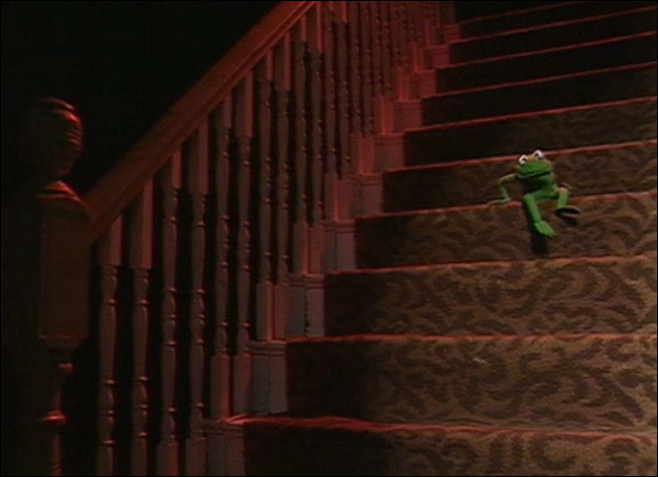
I sat back on the stairs, like Kermit the Frog’s nephew, Robin, and contacted my long-suffering colleagues to explain my temporary absence.
Eventually I got through to the emergency maintenance contractor, who told me that I would be paying time and a half for him to come round with a key and let me in, because it was Boxing Day and nobody works on Boxing Day. I decided not to beg to differ, because I wanted to see the inside of my flat before 2017.
He arrived and let me in with his skeleton key. “Why didn’t you lock the mortice?” he said, as he pushed the door open. “That’s not very secure.”
“Because I didn’t have my key,” I explained, as I handed over a cash sum roughly equivalent to my day’s wages.
And at that moment I resolved that, in 2017, I would not forget the satsumas.
A bauble – not suitable for juggling by small monkeys
TWAS the day before the night before the night before Christmas, and all through the house it was utter bedlam.
Mummy Monkey did a big sigh as she lunged forward to stop the tree from falling over. It was always like this on the first day of the Christmas holidays.
As usual for the time of year, her cheeky monkeys were hyped up on cheap Advent calendar chocolate and the prospect of presents and were bashing about the place, laying waste to it. It was as if a bomb had gone off in Lady GaGa’s dressing room.
“Enough!” she yelled, as she tried to pick glitter off a piece of cold toast. “There will be peace on earth, or, at least, in this living room.”
“You!” she said to her little girl monkey, Georgina. “Baubles are NOT for juggling.”
“You!” she said to her smallest boy monkey, Howard. “Stop laying Lego traps for your father.”
“And you!” she said to her biggest boy monkey. “I want you to go out and find the spirit of Christmas, Eric.”
Eric blinked. “What?” he said.
“You heard,” said Mummy Monkey, as she untangled Howard from the lights.
“It…” said Eric, “It’s just that 1) that seems like an incredibly vague challenge; and 2) you’re seriously sending me out on my own? I’m only eight.”
“Well,” said Mummy Monkey, “1) yes, that’s the point; and 2) this is a generic children’s Christmas story – that’s the sort of thing that happens in children’s stories. Eight-year-old children go out on their own, even though the last time that happened was in 1982.”
“Fine,” said Eric Monkey, and he went upstairs to change out of his pyjamas and into his warmest clothes, including trousers which had a hole in the bottom to accommodate his tail.
Eric stepped out into the snow, and trudged up the road. Trudge, trudge, trudge, until…
He met his friend Rhino. “Hello, Rhino,” he said, “Do you know where I can find the spirit of Christmas?”
“Listen, Eric,” the rhino replied, “do you know how racist that sounds? You’ve got an actual name, but I’m just called Rhino? I have a name too. I have hopes and dreams and…”
“Sorry,” said Eric, “I have been Ukippy. What is your name?”
“Ian,” said the rhino.
“Ian, do you know where I can find the spirit of Christmas?”
“No,” said Ian Rhino. “I am only the first person you have asked. In these things it’s always the third person you ask who has the answer. You’ll have to waste your time with a second person first.”
Off Eric trudged up the road. Trudge, trudge, trudge, until…
He met his monkey teacher, Mrs Baverstock.
“Hello, Miss,” said Eric. “Do you know what the spirit of Christmas is?”
“Where’s your mother?” asked Mrs Baverstock. “What are you doing out on your own?”
Eric explained that this was a generic Christmas children’s story, and anyway, there was no way Mrs Baverstock would have the answer because she was only the second one he’d met, but the author had to pad this out somehow, and they said their farewells.
Off Eric trudged up the road. Trudge, trudge, trudge, until…
He met a human with a white beard and normal clothes who was clearly Father Christmas, but not in his Christmas Eve regalia.
“Hello, kindly human stranger,” said Eric, his tail twitching in case you’d forgotten he was a monkey. “I don’t suppose you know what the spirit of Christmas is, given that you’re the third person I’ve asked and we’re close to the end of the story.”
“You’re in luck,” said the undercover St Nick. “It’s stories like this one, which are boring and repetitive for grown-ups, but which you read to your children one Christmas.
“And then they insist that you read it to them every year after that, because Christmas isn’t Christmas without that story. You see, you do it for them because they love it, and you love them. And that’s the spirit of Christmas. And then one day you don’t get to read it any more, and you miss it.”
“You’re a very wise man, kindly human stranger,” Eric said, “but that’s a bit of a downer. Can’t I just tell Mum it’s ‘letting kids do anything they want, even eating the rest of the Advent calendar chocolate’.”
“Yeah, go on,” said incognito Santa. “It’s Christmas.”
I THOUGHT I would do some Christmas shopping after work, given the season. I reckoned it would be not very busy at that time of day. And maybe I could have a couple of treats at the Christmas market.
There is no such thing as “not very busy” as this time of year, is there? I do not know what I was thinking. Maybe my brain was addled by the tissues I have been using as I struggle with a minor cold.
For I bought some tissues in a hurry and failed to see that they were mulled spice scented. I am not sure what purpose is served by adding mulled spice to tissues. Nobody has ever bought tissues on a whim. It would be like buying scouring pads or bleach on a whim.
Anyway, when I got the tissues back to the office and cracked open the box in order to blow my nose, I was unpleasantly surprised. If I wanted to feel as if somebody had squirted half a can of Glade up my nostrils, I would stand in the doorway of Lush.
Making my way through the crowd of people who also thought it wouldn’t be very busy, I somehow managed to access the shops I needed to visit, by fighting against the stream.
It was long past tea time, or dinner time if you grew up in the south, and I was feeling hungry. After all, I had just done some very strenuous shopping and I could smell sausages cooking over coals. Or maybe I had accidentally bought some frankfurter-scented tissues – it is anybody’s guess these days.
In any case, it was time for the treat I had promised myself. I made my way to a German bratwurst stall and paid five actual pounds for a sausage in a crusty roll. I slathered it with that pointlessly mild mustard that tastes like strained piccalilli and tried to eat it.
It was not an entirely positive experience. First, the amount of pressure my jaws had to exert on the sausage was half that which they had to exert on the roll, so when I bit into it, I did not take into account the differential and most of the mustard ended up on my face.
Secondly, the coolness of the roll and the blandness of the mustard lulled me into a false sense of security. The interior of the sausage was hot enough to melt steel beams.
I burnt my tongue and the roof of my mouth and I had to use the mustard to cool my mouth down. In what sort of zany mixed-up world must the Germans live where mustard is considered a coolant? Do they use Tabasco sauce for eye drops?
I deposited £1.38 worth of nuclear sausage and bread in the bin along with a yellow mustard-smeared napkin. And then I saw it. A stall selling mulled wine…
Maybe the tissues had altered my body chemistry, but I felt the mulled spices calling me. “Cad I had a bulled ine, blease?” I asked, my cold and injured tongue combining to make me incomprehensible.
“What’s that, love?” asked the woman behind the counter, who knew perfectly well what I wanted and was clearly playing with me. She worked on a mulled wine stall. What else might I have wanted?
“Dat dere!” I said, as I pointed at a vat of steaming stuff. The woman ladled some into a waxed cardboard cup and handed it to me.
“Ow!” I said. It was hot. Waxed cardboard, you see, is not brilliant at insulating heat, which is why in coffee shops they give you an extra bit of cardboard to wrap around your cup. And they give you a lid to prevent spillage.
Mulled wine stalls, however, treat these innovations as devilish tricks, and probably European. How on earth was I supposed to carry this cup? I couldn’t swap it from hand to hand till it cooled because I had Christmas shopping, and it didn’t have a lid in any case.
I took a sip, thinking that it would leave a rim of cooler cup around the top. But the problem with mulled wine is it does not have any milk in it to cool it down, unless the stall holder is absent-minded. It was as hot as a German sausage.
I couldn’t carry it, and I couldn’t drink it. And so I poured it into the bin, on top of the other treat I had bought.
I HAD to go to London to judge a cress competition with TV’s Konnie Huq from Blue Peter.
I appreciate that this is an unusual move for a person to make, but what you have to understand is that I am not like you people. I am a much-loved commentator and newspaper columnist who appeared on Channel 5 News once.
In truth, Paul Nuttall, the 40-year-old 60-year-old new leader of UKIP, would be justified in calling me one of the metropolitan elite, right after he had looked up how to spell “metropolitan” in his Collins Junior Illustrated Dictionary.
And I felt the fact that I do not like cress should not disqualify me from judging it. It should not matter that I think cress only exists so that people who like an egg sandwich can think they’re having salad.
So I booked train tickets down to London, and I chose the quiet coach, because life is hard and not long enough to have to listen to people having conversations on their phones about how clever they are for the benefit of the carriage.
Unfortunately, the people in the seats behind me were having a closely-fought wittering contest.
I cannot tell you what they were talking about, as my Cantonese is rusty and, in any case, restricted to items of food, but they were enthusiastic about their many topics of conversation for the entire three-hour journey in a way that was at odds with the concept of the “quiet coach”.
I just wanted to sleep. I had a cold. Besides, I am 45 soon, which renders me technically capable of being referred to as “a local grandad” by rookie reporters in newspapers, and sleeping has become one of my top four favourite leisure activities. But every time I closed my eyes, the thread would be picked up again.
And so, when I arrived at my cress judging session in a London pub, I was not entirely compos mentis. I could have sworn it cost me more than £10 to buy two pints for me and the head judge, but that is clearly impossible.
TV’s Konnie Huq from Blue Peter
Anyway, the head judge immediately told me that TV’s Konnie Huq from Blue Peter would not be joining us, and had emailed her cress picks instead. “Oh,” I said, “Ah, well, the important thing is the cress. I am not the sort of person to have my head turned by celebrity.” And then I went to the toilet and kicked a bin.
Joined by the rest of the judges who turned up, I judged an interminable number of pictures of cress, using a set of criteria so esoteric that to the general public it would look as if the panel had just chosen a winner at random.
My cress appreciation obligations fulfilled, I faffed about London for a bit. I saw the sights – some chicken shops, a pigeon, and a Costcutter – and I bought a 65p packet of paper tissues from a newsagent’s for £1.95.
It was time to go home. What I needed was the tranquillity of the Quiet Coach. There was no way, I thought, I would have that couple sitting behind me again. Unless they were coming back at the same time…
I put those thoughts out of my mind and boarded the train. This was promising. There was a bit of bustle as people stowed away their luggage, but conversation was carried out at a volume unlikely to get oneself busted for talking at a silent monastery.
I flumped into my seat and closed my eyes. And then he came. The man who would sit next to me.
He was wearing roughly nine layers of clothing, and proceeded to remove seven of them. Five of those seven hit me as he cast them onto our shared space.
He kept standing up and getting things from the overhead rack throughout the journey, but every time forgot two things. One, that the tray was down. Two, that his shirt was not long enough to conceal his navel.
And so each time he stood up, he would bash his knee against the tray, cry out in pain, wake me, and then expose me to the deep inky blackness of his belly button. I can still see it now.
He even turned the pages of his book loudly, after licking his index finger and thumb with a smack of his lips EVERY TIME.
He was, by far, the noisiest silent person I have ever encountered.
I bet this stuff never happens to TV’s Konnie Huq from Blue Peter.
If you want to make my cress judging worth my while, go here and donate a small amount of money to Children In Need. Or a large amount. Actually a large amount would be better.
SOMETIMES it seems that I am engaged in a competition with myself to see if I can have an accident which is simultaneously unbelievable and unnecessary, and yet could only happen to me.
One contender is the time I bruised my coccyx while attempting to assist a fellow passenger’s exit from my bus. I stood up to let her out just as the bus went over a humpback bridge, was knocked off my feet, and sat down on the floor unexpectedly and forcefully.
Another is the time I attempted to ride a junior motorcycle at a fair in Welshpool. As I pulled back on the throttle, the bike sped out from between my legs. In a panic, I maintained my grip on the handlebars, increasing acceleration, until the bike pulled me through the air and into the crash barrier.
Up to now, the unquestioned leading contender is the occasion on which I was in Matalan and distracted by my phone, which meant that I did not see the oncoming woman in the mobility scooter, who crashed into me, knocking me into a spinner rack of bras.
However I was not physically injured in that altercation with an electric vehicle. I was a little scuffed, yes, and my sleeve became attached to a hook, and I now have an aversion to doilies, but the only thing that was hurt was the last few dregs of my pride.
You don’t have to have a PhD in narrative studies to realise that this is leading up to the news that I have a new contender for the top spot.
I was going to visit my brother in hospital, but I could not turn up empty handed. I needed to buy a get well soon card.
I should say at this point that I am not sure about get well soon cards as a concept. They seem like an added pressure on people who are already struggling. “Stop malingering, you lazy article. Get well soon. Don’t stretch it out, I’m on a clock.”
But the alternative was to look as if I were totally OK with him not being well, and so a get well soon card was the lesser of two evils.
I went to the big supermarket near the stop where I would catch the hospital bus. This supermarket has railings running around its car park, the official entrance was about 100 metres away, and I had six minutes to buy the card and catch the bus…
I went rogue, readers. I climbed the railings like a person who is not nearly halfway to 90 years old. I swung my leg over and…
Nothing bad happened. I can climb railings. I am not a complete imbecile. Not everything I do goes wrong.
I rushed across the car park and into the supermarket. There was a knot of people bimbling about the section of the card rack appropriate to my needs.
Every time I tried to grab a card, one of the people would move in front of me, as they pondered which of the mass-produced cards before them most accurately reflected their complex feelings and relationship histories.
It became infuriating. Time was ticking by. In the end I thrust my hand between a man’s legs – not intentionally, he moved at the last moment – and yanked a card from the rack. It would have to do.
I bought it and raced out of the supermarket. My bus was due in 90 seconds, and, knowing my luck, it would be on time for the first time ever. I rushed back across the car park towards the railings.
I clambered over them, practised, catlike even, dropped to the other side…
And I cut my face on the get well soon card.
I am not even sure how it happened. All I know is that paper cuts really hurt. I was actually bleeding.
It is not just that it hurt, but it was ridiculous. Paper is so unthreatening that the only reason “paperweight” isn’t the lowest weight in boxing is because stationers complained it would be confusing.
How can you be hurt by paper? It’s like being hurt by a bar of Milky Way, or the breath that curls from your mouth on a cold day.
And yet, there I was, bleeding from my actual face as I clambered onto the bus.
“Are you all right, lad,” said the bus driver. “What happened?”
“Cut myself shaving,” I said. The truth was too unbelievable.
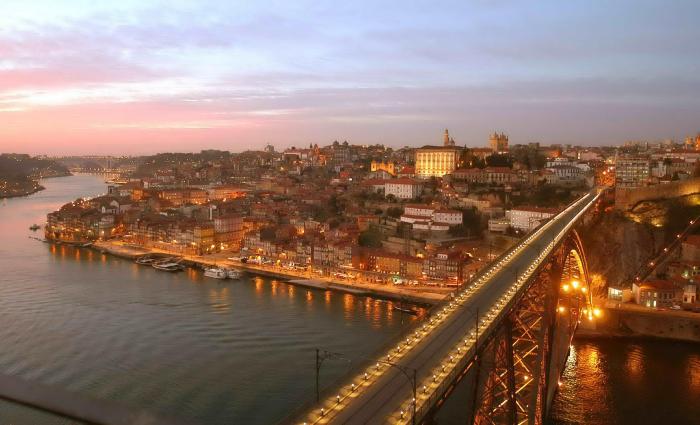
Sunset over Porto. Over everywhere on the same longitude, I suppose
AS the early evening autumn sun shone over the Douro Valley and into the barn, warming the stone, our beautiful guide launched into a haunting lament, the fado, the melancholy soul music of the Portuguese.
It was a moment of pure romance, undercut only by the fact that I was standing barefoot in an 18-inch deep pool of squashed grapes. It’s hard to look suave and worldly when your legs are stained purple up to the thigh.
And yet, it was hard not to think that the whole trip had been leading towards this point. I had arrived in Porto on a Ryanair flight from Liverpool a couple of days before, leaving the gloom behind to be warmed by the sun of a Portuguese autumn.
“Porto? Is that in the Algarve?” I was asked before the trip. “No, it’s in the north,” I said. “Who goes to the north of Portugal?” I was asked. “I’m not sure,” I said.
On that first night, it was impossible to get a proper sense of the city, beyond the fact it was both buzzy and hilly, so our resourceful guide, Ricardo, took our party to Cantinho do Avillez.
Cantinho do Avillez – I sat on the chair at the front of the picture with its back to us. This picture is unrepresentative of the number of people there that night
This is a restaurant owned by one of Portugal’s brightest new chefs, Jose Avillez, and featured clever twists on traditional Portuguese cooking, beginning with bread and truffled butter, with a tomato “cream” which tasted more of tomatoes than most tomatoes, and finishing with a sort of backwards salted praline ice cream, which started like custard and ended an icy solid, in defiance of both usual ice cream practice and the laws of physics.
Fed and relaxed by local wines, we returned to our hotel, the five-star Crowne Plaza, on the Avenida da Boavista, the road which leads to Porto’s Atlantic coastline. It was a fine, business-like hotel, catering for the international traveller, with a bed roughly the size of your living room.
Porto itself is a handsome city, elegantly ruined in parts, with twisting back streets leading downhill to the Rio Douro, the river which irrigates the valley of the same name and runs out to the ocean, and breathlessly modern in others.
Casa da Musica
And it was the modern Porto we saw first of all the next morning – namely the Casa da Música, the great concert hall, designed by Rem Koolhaas, and built as part of Porto’s successful bid to be European Capital of Culture in 2001, though not completed until 2005. A stunning angular hunk of concrete, it looks as if it has landed like a spaceship in a formerly run-down part of Porto.
From there, we went to the Contemporary Art Museum of Serralves, set in acres of parkland and gardens. There are no permanent exhibitions in there, which means it continually reinvents itself, as Porto itself did as a result of Capital of Culture, using the honour to transform the city, just as Liverpool did in 2008.
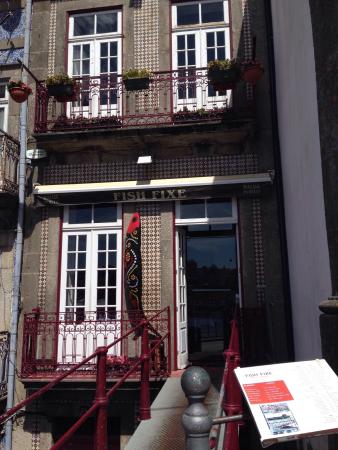
Fish Fixe – pronounced ‘fish fish’
All that culture can make a man hungry, and so we sat at one of the outdoor tables at Fish Fixe, on Cais da Ribeira, which runs down the bank of the Rio Douro, where we ate sardines and cheese and ham, dipping bread in peppery oil made from local olives. We followed them with arroz marisco – a soupy mix of rice and seafood which every respectable Portuguese mae can make for her children.
Across the narrow river we could see the port houses of Gaia, the cellars in which are held the port wine which was both named after the city, and upon which most of the city’s historic wealth is based. Huge signs above the houses carry names like Sandeman and Taylor’s, names of British exporters who produced and took port to our country in the 18th and 19th centuries.
After lunch we took a tour round the cool dark Sandeman cellars, accompanied by a woman guide dressed like the Sandeman logo, the Don, a Zorro-like character in a black Spanish sombrero and black cloak, which Portuguese students traditionally wear, and discovered how port is made.
The Sandeman cellars – tawny port as far as the eye can see
So, here’s the science part. Unlike sherry, which is wine fortified with brandy and sweetened after it has fermented, port is only partly fermented, before the fermentation process is stopped by adding a flavourless colourless brandy. This means the port packs a 18% alcohol punch, while retaining the sweetness from the grapes.
Red grapes make ruby port, white grapes make white port, and tawny port is ruby port which is aged in much smaller barrels, which means more of the wine has contact with the wood so more oxygen can get in, changing the drink’s flavour and turning it into a honey colour.
The insane staircase at Livraria Lello
After a tasting of the three ports, our trip guide, Ricardo, took us to Livraria Lello, Porto’s most famous bookshop. It’s so famous it has a bouncer on the door and you have to buy a ticket over the road to get in.
It’s because it’s considered to be the inspiration for Hogwarts castle in the Harry Potter books. The theory has some weight. It’s very ornate and has an eccentric staircase. And JK Rowling lived in Porto for a few years while she was writing the first book in the series. It meant the shop was packed with Potter fans who, crucially, were not buying books.
“So, I expect this crowd are all here because of Rowling,” I said to the bookshop guide. “No, no,” he said, “this is a very important and historic place for Portuguese literature,” as he was jostled by three small children in wizard hats.
After a quick trip to Porto’s main railway station to see the stunning blue and white tile pictures which decorate the concourse, we got ready for dinner at Porto Cruz, another port house. But while Sandeman’s is big on history, Porto Cruz is about modernity, with a swish rooftop bar and restaurant, serving port-based cocktails with excellent food.
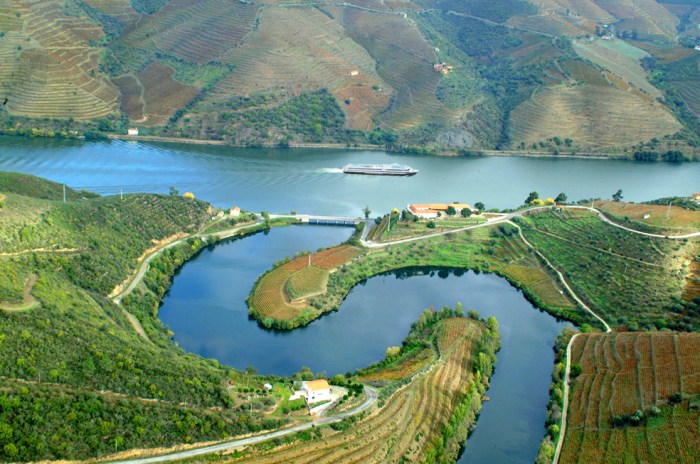
The Douro Valley – it’s quite nice
The following day we headed into the Douro Valley, the lavishly attractive source of the grapes which make the wine of the region. It is hardly any exaggeration to say that every part of the valley that is not a road, or water, or a house, or another business, is covered in vines, running along the terraces which cling to the hills.
The Douro was one of the world’s first demarcated wine regions, cold in winter, baking in summer, the sun beating down on the soil, which is covered with flat gravel, which soaks up the heat and releases it at night, keeping the temperature constant.
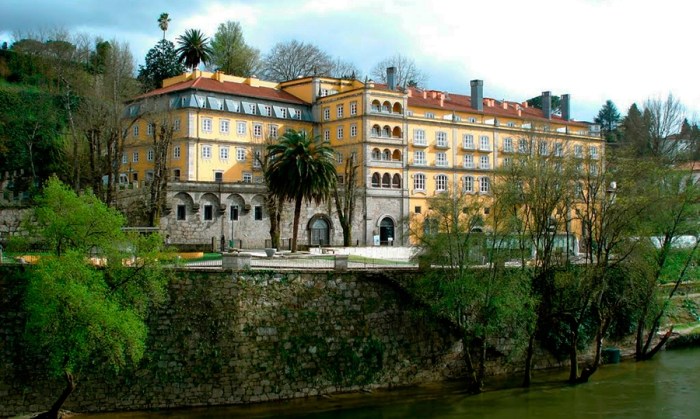
We went first to Amarante, a small golden town with an A-Level in charm, and a weird line in phallic-shaped biscuits. We had a traditional British afternoon tea at Casa da Calçada, a gorgeous villa of a hotel, with hefty fireplaces and comfortable sofas. The relationship with Britain is important to the Portuguese – we liberated them from Napoleon and we frequently got stuck into the Spanish – in a way we rarely reciprocate. Our loss.
Casa da Calcada in Amarante – I wish I knew how to do cedillas in captionsThe wine library at the Six Senses Hotel in Lamego – all hotels should have a wine library
After a wander through the bridge-crossed town, we headed further into the valley, to the Six Senses Hotel in Lamego. An unprepossessing entrance gave way to pure luxury, a modern hotel which was shot through with comfort and elegance, with everything just so, and amazing views of the valley. It was too good for the likes of me, quite frankly.
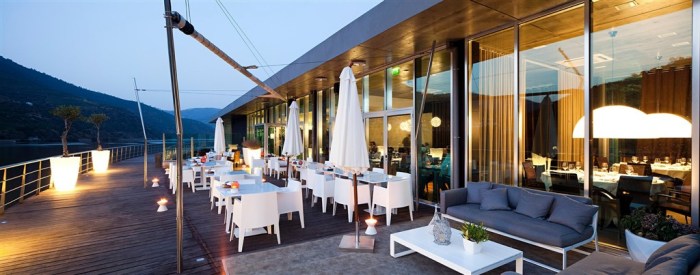
We sat on the terrace and ate veal and potatoes while we listened to absolutely nothing, a peace and quiet I have never before experienced. I gazed out at the wine terraces, the olive trees framing the crest of every hill, and felt an almost transcendent sense of calm. It was basically the cosmic opposite of the London Underground.
The Wine House Hotel at Quinta da PachecaThe terrace at Quinta da Pacheca looking out at the vineyards
From there we went to Quinta da Pacheca, a lush green vineyard and medium-sized wine producer with its own four-star hotel. The sun dappled the terracotta roofs of the whitewashed buildings through the rustling leaves of the trees. There was a touch of lavender in the air. I looked at the unapologetically modern cantilevered first floor extension on the main hotel building and was smitten. I felt I wanted to…
GRAMOPHONE NEEDLE SCRATCH SOUND EFFECT HERE.
“So I will take you on a tour,” said our quinta guide, “and then you’ll be treading the grapes.”
“Hooray!” said the rest of our party.
“What?” said I. Maybe I am odd, maybe I am too damned buttoned-up, but I did not consider this much of a gift. Sloshing about thigh-high in pulverised fruit is not my idea of a good time, it is a forfeit in a Noel’s House Party game.
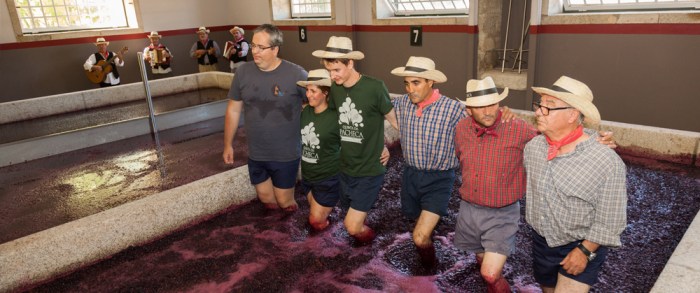
But after the tour, during which we sampled the producer’s excellent ruby and ridiculously good tawny port, as well as their fruity, if tannic, table wine – “It needs a little time to mature”, said our guide – we were taken to the granite vats, where we changed into T-shirt and shorts, and washed our feet before plunging into the grapes.
It seems ridiculous in the 21st century that treading the grapes is still a thing, but our guide explained that stainless steel presses, which some of the bigger producers use, crush the seeds, making acid leak into the wine and impairing the flavour. On the scale of production of this quinta, it makes more sense to use the old methods. And the alcohol kills off anything bad anyway.
I decided to take her word for it and stepped inside, joining a seven-strong crew as we marched back and forth, arm in arm, to the rhythm of songs sung by the Portuguese contingent. Apparently, walking in step to a rhythm reduces the chance of a stumble. And nobody wants to fall over in that.
I did this. I didn’t wear a hat, though. I have my limits
Despite my qualms, it really did feel like an honour in the end, as if I had taken part in something ancient.
It wasn’t over yet. To finish our visit to the valley, we were taken to chef Rui Paula’s DOC in Folgosa. Paula is one of Portugal’s most inventive chefs, and there, on a wooden terrace, we ate a modern and witty five-course meal, each course matched with a wine from the region.
Sitting on the banks of the Douro, watching the lights twinkle on the jet river, drinking wine from grapes harvested a few miles away… it wasn’t a bad way to round off a visit to one of the most beautiful and underrated regions of Europe. Who needs the Algarve? Northern Portugal has so much more to offer.
I HAVE been avoiding little messages for a few months now, little reminders which pop up in my email, or in my actual mail. They started with “Your eye test is due soon”, moved on to “Your eye test is due”, and became “Your eye test is overdue.”
It is like holding onto a runaway hot-air balloon, knowing that if you let go of the rope, you will fall, but also aware that the longer you leave it, the harder you will hit the ground. Avoidance is my default setting when dealing with difficult situations.
But this week, a bird flew into my armpit, forcing me to let go of the rope.
I was at my desk at the beginning of my shift, doing whatever it is I do for a living, tapping away on a keyboard, and moving a mouse, appearing to passers-by as if I know what I do for a living, when I heard a sound, something between a ping and a boing, somewhere around my temple.
I am not a trained medic, but even I knew that sounded like bad news. And then I had a terrible pain in my eye. “Oh, dear,” I thought, “am I having a stroke?”
No, I was not having a stroke, readers. What had happened is that one of the lenses of my glasses had sheared away from part of its housing and had now taken up residence on the surface of my eye.
I have never fancied the idea of wearing contact lenses, and if this was any indication, I was right.
I removed my glasses. This was not so much a transformation of Clark Kent into Superman, and more Clark Kent into Colonel Blink: The Short Sighted Gink from the Beezer.
If I squinted I could see my computer screen, which was fine, but I also looked baffled by the idea of words, which is not ideal when one works in newspapers. “Where are your glasses?” a succession of colleagues asked me, before assuring me that things could not possibly be that bad.
I showed them. “Can’t you just fix them?” they asked. It turned out I could not. The springiness of the frame which previously kept the lens in place also prevented glue from working.
“Don’t you have a spare pair?” they asked. I began to tell them the story of my recreational walk in the rain which culminated in the destruction of my other pair under the wheels of several vehicles, but they stopped me. “Of course you don’t,” they interrupted.
There was nothing for it. I let go of the balloon and booked an eye test for the following morning at my usual opticians. My optician is great, I thought. I started going there about 12 years ago, almost entirely because it had a same-day service. I won’t say the name of the company, but it’s along the lines of Super Speedy Glasses.
I could cope for 24 hours without glasses, I thought. I would be asleep for eight of those. This would be fine. I just needed to get through one day of looking as if everything confused me.
My eye test passed without incident, and I went into the main shop to choose my frames. You will be pleased to know I picked a tasteful, non-comedy pair.
And then I sat with the sales assistant, who went through the range of options which were not part of the basic package but which everybody needs.
Has anybody ever said, “No, I don’t think I will have the anti-glare protection, as glare is one of my favourite things?” Opticians these days are like budget airlines. “Oh, you want to sit INSIDE the plane? That’s another £23.”
When she had stopped adding things to the bill, the sales assistant told me my glasses would be ready some time in the next seven days.
“No, I’d like the same-day service, please,” I said.
“I’m sorry, we don’t do that any more,” she said.
My eyes creased up. No longer was I simulating confusion. “But that is your selling point. That’s the only reason I came here.
“Your name is Super Speedy Glasses. That’s like British Airways getting out of the airline business and going into cupcakes, but still being called British Airways.”
The shop assistant smiled at me beatifically. I was clearly not the first.
So I have to manage for a week without glasses. I should avoid me if I were you.
AT THIS time of year, I mostly find myself angry with myself for not understanding how seasons work.
I should know by now that in November I need to be suitably prepared for those blustery, sunny, windy, rainy, warm, and snowy days we have, but I just assume a non-waterproof coat will see me through. I am like one of those people who express surprise at the shorter days in winter or those who are rescued from Snowdon in their flip-flops.
Allied to my unpreparedness for predictably unpredictable weather is my inability to keep an umbrella for more than a few days. My record for the shortest time between buying an umbrella and losing it is one and a half days.
I don’t know why it should be umbrellas which I single out for this treatment. Everything else I accumulate I seem to be incapable of ditching.
I still own clothing with St Michael labels. Some of it might even come back into fashion again, which will be great as I rock a Six Million Dollar Man T-shirt and Black Watch slack. Essentially I am half man, half Velcro.
As I left my chosen form of public transport, I was aware that it was raining, owing to the fact that water was falling from the sky and it was wetting me. I won’t lie, this disappointed me.
“What I need,” I thought, “is an umbrella, such as we know Rihanna would have.” Why I was thinking of Rihanna, we will never know for sure, but it was probably to help whoever has to think of a picture to place on this column.
I scrabbled in my bag for an umbrella, but, of course, there was no umbrella there.
All that was left were two black sheathy things which covered umbrellas I had previously owned, ghosts mocking me for my placing of wet umbrellas on the floor of buses, and subsequent alighting from the buses without them.
The rain was splattering the pavement, leaving dinner plate-sized impressions on the stone. I needed shelter, or when I got to the office somebody would say, “Oh, is it raining?” as I dripped everywhere, like an ice statue left near the radiator, and I would have to commit murder.
Then I remembered there was a key-cutting and shoe-repair shop nearby which sold umbrellas. I am not sure why a key-cutting and shoe-repair shop would diversify into umbrellas, but I suppose if you have chosen to put two random and unconnected things together under one roof, you might as well add a third.
I stumbled into the shop, as the rain lashed the street behind me, setting off car alarms and exciting ark builders. I pulled an umbrella off its hook and took it to the counter. “That’s £4,” the shopkeeper said. “Will you be using it now?”
I looked at him as a drop of water rolled off my eyebrow. “Yeah, you will,” he said, and he pulled the tag off the umbrella.
I handed him my card. “Oh,” he said, “we don’t take cards.”
“But you’re a shop,” I thought. “I could understand it if you were a homeless person or a carol singer, but this is 2016, for heaven’s sake.”
“Oh,” I said. I did not have £4 on me. In other circumstances, I might have left and searched for umbrellas elsewhere.
But the shop assistant had pulled off the tag. I had basically bought the umbrella at that point. That is the rule of buying umbrellas.
“Where’s the nearest cash point?” I asked. “Ooh, just down the road,” said the shopkeeper.
“Right,” I said. “I’ll be back.”
It was not “just down the road”. It was a considerable distance down the road. The wind whipped up, flinging rain somehow inside my shirt sleeves, as I trudged down the road.
I joined the back of the ATM queue, withdrew the cash from the machine, and walked back, the wind now depositing the rain on my previously dry back. I handed over the money, keenly aware that had I just gone to work I would be steaming dry by now.
He gave me the brolly and I stepped out of the shop. Putting up the umbrella was now a futile gesture. I looked as if I had dived for a rubber brick. But I did it anyway.
The wind caught it, turning it inside out and mangling it for good. On the plus side, I now have a new record.















 Gary Bainbridge