I Told You So. Are You Going To Listen To Me Now? (SPOILER: No)

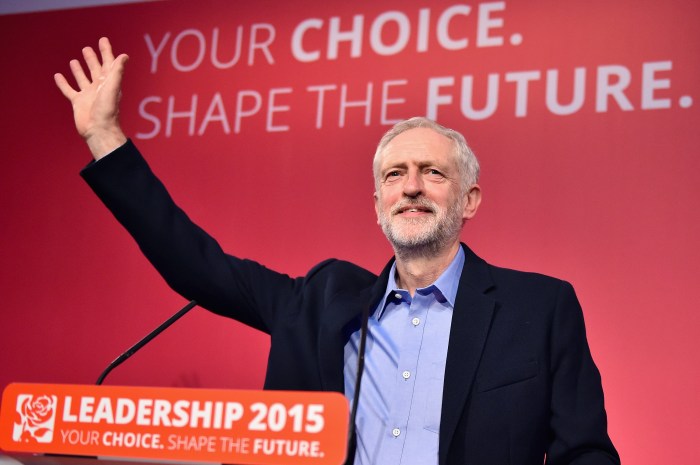
<> on September 12, 2015 in London, England.
YOUR choice

THE moment Jeremy Corbyn was elected as leader of the Labour Party for the first time I was writing in the library. I doubt there was a person in there who didn’t hear my anguished cry.

I immediately wrote an intemperate tweet which suggested that perhaps the people who had voted for him might eventually come to regret their choice, and eventually took it down because I had called people I like and respect “gobshites”.

I am not going to say that everything I predicted was correct. I suspected that Corbyn’s old-time religion would pile up votes in Labour strongholds while putting off voters in swing areas. I was wrong. Mea culpa. I vastly overestimated his appeal.

Now I absolutely get why Corbyn appealed to Labour Party members and the three-quid recreational leftwingers. Labour had just lost an election which it was expected to win, like in 1992, and supporters were upset.

“We’ve already had to put up with Miliband saying he’d keep half an eye on immigration,” they said, “and now this?! You’re expecting us to vote for somebody like Yvette Cooper? Or Liz Kendall?!”

And then Corbyn came along, with those soothing words that told you what you wanted to hear: “It’s not you that’s wrong, it’s the electorate. Let’s not bother convincing those Tory voters, let’s just enthuse the non-voters and build a bright, etc, etc.”

No wonder you voted for him. Losing an election is tough. Being told that the reason you lost it is because you didn’t work hard enough to accommodate people to the right of your party is even tougher.

No wonder you took the easy way out. And then you justified it by saying that people have had enough of “moderates”. That’s the message you were getting from the electorate, oh yes.

You heard that message in 2010 when Brown was turfed out of office, and you heard it again in 2015 when that notorious Blairite Ed Miliband was defeated at the polls.

But it’s absolute nonsense, isn’t it?

Brown lost in 2010 because Labour had been in office for 13 years, and he was at the wheel when the economy crashed. It doesn’t matter how well he and Alistair Darling did to pull the country back out of recession, or how influential he was in saving the world economy.

Nor does it matter that the crash was caused by the collapsing loans market in the United States, and not because Labour spent some money on fixing school roofs. The fact is he was in charge, so he got a pasting.

Even so, if the Tories had been led by Michael Howard or Ian Duncan Smith in 2010, Brown would probably have beaten them. But they were led by “a moderate” who had spent three years reassuring the electorate that he was a safe option.

Yes, in power David Cameron presided over a dreadful right-wing shambles of austerity and bedroom tax and Brexit, but he had a plausible manner. He spoke like a centrist. “I’m not one of those old-style Thatcherite hang ’em and flog ’em Tories”, he said to the electorate, “I hug hoodies and huskies and I like The Jam and don’t mind the gays.”

Unfortunately, after the 2010 election, the Labour selectorate learnt the wrong lesson. Did they pick the wrong Miliband brother? I don’t know if it’s that simple…

miliband

But what they did do was pick the most left-wing candidate on offer who wasn’t a black woman. They picked the candidate most likely to spend the next five years saying how dreadful the previous Labour administration had been. And who wasn’t a black woman.

And in 2015, what happened? The Lib Dems collapsed, mostly because the Labour voters who had defected to them because of Iraq and tuition fees wanted to punish them for entering into coalition with the Tories, and the Lib Dem/Tory floating voters were sufficiently reassured by Cameron’s government to decide they did not need Clegg’s restraining hand.

It wasn’t because of a collapse in support for centrist politics. Cameron still painted himself as centrist. He did quite well out of it.

Miliband tried to paint himself as centrist to the broader electorate, and radical to Labour members, which was a difficult trick to pull off and one which he failed to do. But that was not the problem he had.

People decided early on in his leadership that he was not prime ministerial material, just as they had with William Hague, Ian Duncan Smith, and Michael Howard.

And Scotland went full centrist. The SNP is completely Blairite, apart from the constitutional issue, and its position on Trident, which is bound up with the constitutional issue.

The point is, centrism and moderation are not the problem here. It’s about credibility.

So when Corbyn came along in 2015 saying all the things you wanted to hear, and you convinced yourself that the problem with Ed Miliband was that he was too right-wing, and that’s why people went for the Tories, you were wrong. You were so wrong. You were 20-points-behind-in-the-polls-a-month-before-a-general-election wrong.

I’m a centrist. But I’m a centrist who knows that centrism isn’t enough. You need the electorate to believe that you have a leader who is prime ministerial, a leader who goes to where most people are, and gently pulls them in the right direction, rather than standing miles away from them with a megaphone and placard, a leader who says some things that they want to hear and that you don’t.

And what did you do? You picked a man with no experience of office, who has never seen a British foreign policy he liked, or an authoritarian left-wing leader he didn’t like. A man who won’t sing the national anthem. A man who is “always on the right side of history” – apart from Kosovo, the Anglo-Irish Agreement, and that time he founded an organisation which then called for insurgents to kill British soldiers in Iraq, before becoming its chair.

Oh, yes, and that photo of him opposing apartheid – as if that were an unpopular position in Britain in the sixties to the nineties? That’s at a protest which the bulk of the British anti-apartheid movement did not want to happen.

As my dear friend Twll Dun says:

…what actually emerges from our brief potted history of a picture of Jeremy on a demo is not a lone man, prescient in his opposition to the evil apartheid regime. Instead, it is a man who – when an idea is already mainstream and backed by the vast majority of the left – finds himself drawn to a demonstration organised by those on the wildest shores of it, a demo the utility of which – centred entirely around the right to keep a non-stop picket outside an embassy – to the wider cause of the movement is debatable, to say the least.

You picked a man with absolutely no hope of becoming British prime minister – and a long history of opposing the EEC/EU – and you knew all this before you voted for him, because you were told.

And all this because you didn’t want to compromise. Because you were happy to make the perfect the enemy of the good.

That’s fine if you’re on the far left of British politics. If your concern is about building a populist protest movement, then you know what Jeremy Corbyn is and how he would be as leader. I have no problem with you. You had an objective and you succeeded. Fair play to you.

But the rest of you, the ones who voted for Jeremy Corbyn because you thought he was the most likely to become Prime Minister – what on earth were you thinking?

I’m a centrist. But there’s a line at that centre. I’m probably far closer to some people on the other side of that line on many subjects than I am to the leader of the Labour Party.

But I won’t cross that line, because in the end I think people who have all the advantages have to help those people with none of the advantages – not that they ought to help them, not that they should be encouraged to help them, but that they have to help them. It’s not a matter of charity, it’s a requisite of civilisation.

That’s why I have to vote Labour at this general election. Not because I think Jeremy Corbyn is good – I think he would be a terrible Prime Minister, incapable of taking the sort of quick and ruthless decisions with which Prime Ministers are faced.

But I think Theresa May has demonstrated she is a much worse Prime Minister. I believe she will pursue a disastrous Brexit and leave the public realm devastated for generations, while Corbyn would pursue a slightly-less disastrous Brexit and keep the NHS and schools ticking over until a proper grown-up who can do sums could take charge.

If you’re on the same side of that line as me, you should do the same. Being an adult in British politics often means voting for the unsatisfactory to avoid the worse. I told people before Corbyn was first elected that they were making the perfect the enemy of the good. It would be inconsistent for me not to follow my own advice.

But don’t bloody make me do this again, you gobshites.

COLUMN: May 4, 2017

hulk
A friend from work
I ADOPTED the correct stance, feet shoulders-width apart, the club gripped tightly, right hand above left hand, and breathed in. I could see the hole, so tantalisingly close.
The onlookers held their breath too. If I sank this ball in one, I’d be back in contention. The pressure was unimaginable.

I addressed the ball, and then swung the putter, fluently. It hit the ball, square and true, and the ball went on its way toward the hole.

But I’d hit it too hard.

It went up the ramp and instead of it going down the other ramp and into the hole, which was in a specially adapted toilet, it bounced off the wall and rolled back to hit my foot.

“Ah,” I thought. “This is exactly what I feared would happen.”

It was my own fault. I had been incapable of getting out of a work’s night out because I did not have a plausible excuse. This is what happens when you do not have a plausible excuse.

“What we’re going to do,” my cheerful colleague informed me, with menaces, “is go and play crazy golf at a place called Ghetto Golf.”

If I were to play a game called “Name two things beginning with the letter G that would never be associated with you” I would find it hard to do better than “ghetto” and “golf”. I think only “glamorous” and “gung-ho” would beat them.

Ghetto? I am a middle-aged middle-class man, so white I could use Tipp-Ex as foundation. I am not so much street as cul-de-sac. My favourite rap song is Rapture by Blondie.

And as for golf? One would expect of the author, given what has just been written about his middle-aged middle-class whiteness, that he would be all over golf like yellow corduroy on Nigel Farage’s legs. But one would be wrong. Dead wrong.

I am not saying that the fact that golf clubs are full of Farage types, who blame everything on brown people and gays and women, is the thing that puts me off golf, although it doesn’t help.

It is more the fact that, owing to virtual blindness in my right eye, my depth perception is shonky to the point of comedy. I can only catch a ball by accident. It takes me three attempts to pick up a cup of tea set down in an unfamiliar place. I am reluctant to tell you what else can go wrong.

So, not only am I incapable of judging the direction or speed of the ball when I hit it, it is anybody’s guess if I will hit the ball in the first place.

Essentially, if you were to design a sport that was so much not for me that it makes me appear good at all other sports in comparison, then you would come up with golf, a game in which the trickiest drive is no harder for me than the simplest putt, in the worst possible way imaginable. I can miss a putt from two inches away.

This means that crazy golf is just as difficult for me as actual non-crazy golf. Or golf, for short.

I took a second shot, while the RnB and rap music on the PA echoed around the re-purposed brewer’s hall. This time the ball missed the ramp, settling, after a couple of rebounds, at the side of the ramp. I took another two shots, somehow positioning it at the foot of the ramp. I could not possibly miss now.

I hit it. The ball flew up the ramp, hit the back wall again, and rolled back to the painted white cross where the ball had begun its humiliating ordeal at my hands. There was a ripple of sarcastic applause from the crowd in the bottleneck I had caused.

This was my sixth shot, my last chance for redemption. I lined up the shot, I hit it, it flew up the ramp and hit the back wall again.

But this time, miraculously it did not come all the way back. Instead it rolled the way it was supposed to, down the second ramp, and into the toilet-shaped hole. I did it!

It was the story of my life: a series of embarrassing errors, leading up to a final success, which still ends up in the toilet. To a background of sarcastic applause.

I don’t remember much of the rest of the holes. I was too busy having a nice time with friends from work. Not everything ends up in the toilet.

COLUMN: April 27, 2017

IMG_20170120_133731_789
A distressingly pleasant day

I WAS in far too good a mood. The sun had been shining, and my working day had been almost entirely bump-free apart from the usual vending machine issues.

The issues? Well, it is one of those vending machines which fail in every way. It does not want my money. And when I somehow get it to accept my money, it refuses to give me the item I wish to buy. I am not sure if it is incompetence or snootiness. Nevertheless, I chose not to let it bother me.

I walked through town towards my bus stop, drinking in the sun, though not drinking anything else because of the aforementioned vending machine issues.

It was one of those days where it felt good to be alive, and not just because of the alternative. Fresh leaves were on the trees, the pavement cafes were filled with decorative and sappy young people, and even the vapours from the robofags being puffed on by escapee office workers smelled of butterscotch and lemon drops.

There was a woman at the bus stop I thought I recognised, which is unusual for me. I am awful with faces. And names, as it happens. And cars. I would make a poor crown court witness. “It was definitely a person,” I would say, “beyond that I can tell you nothing other than he made off in a red brum brum. Or it might have been purple. Or she, come to think of it.”

I stared at the bus stop woman in puzzlement – had I worked with her, I wondered? Do I currently work with her? Had I met her at a party? I’m never invited to parties; it couldn’t be that.

But the cheeriness engendered in me by the pleasant day had made me sloppy, and made me drop my natural caution. I had stared for about a second too long. And now she was looking right back at me, with a gaze which said, “Who do you think you’re looking at, you four-eyed sleaze?”

“Argh,” I thought. “I still have no idea who you are and now you have caught me staring at you, which was very much not my intention. I know, I will pretend to be looking past you. Yes, if I act “naturally”, there is no way you will think I was staring at you, which, yes, I admit I was, but not in a way which would get me in trouble with HR if it turns out I do actually work with you. Oh, please come, bus. Please come right now.”

And, as if by magic, it did arrive. And I could have made a plausible case that I was definitely looking past the woman to check the number on its front if it ever came to court.

We both boarded it – because life is never easy – and we sat down, with me as far away from her as possible. I stared at my phone. It was for the best.

But somebody said something funny on Twitter, and it made me smile broadly. It was so funny that I could have written “LOL” in response, even though technically that would have been a lie, and I forgot for a moment that I was supposed to be looking down. I looked up, beaming, just as she turned around.

“Great”, I thought. “First I stared at her in an unnerving way, and now I have flashed her a big grin. I might as well just hand myself in at the police station.” I kept my head down. Again.

The bus approached my stop, and I flew to my feet, whooshing past the woman. At least she wasn’t getting off at the same stop…

She stood up and followed me off the bus, in fact, if not in intention. This was an unwelcome if predictable development.

I ducked into a mini-mart near the bus stop to prove to her, once and for all, that I was not a malevolent stalker. I didn’t need anything, but it was a useful hiding place until it all blew over.

But then I remembered I needed some milk. Oh, and some washing-up liquid.
And as I reached for the washing-up liquid so did the woman from the bus stop.

“Gah!” I said. And then my mouth said, before my brain could stop it, “We must stop meeting like this.”

I have no idea what I was thinking. I blame it on the sun.

She regarded me with befuddlement. I suspect she did not recognise me.

COLUMN: April 20, 2017

evel
An accurate representation of Evel Knievel

I AM still trying to get over the Prime Minister’s recent proclamation that this country is totally united… apart from that lot over there, you know, the splitters.

Of course, she can get away with this self-evident illogical nonsense because she is the only party leader with whom you could imagine leaving your spare keys when you went on holiday.

This is why the polling gap between her and the leader of Her Majesty’s Opposition is so wide Evel Knievel would cry off jumping it, claiming he had a verruca and carrying a note from his mum. Never underestimate the electoral power of the Keys Test.

But the fact is, Prime Minister, this country is hopelessly and hilariously divided. There is a crack that runs down this country, splitting communities and even families, and the people on the losing side are bitter and angry. And no wishy-washy wishy-hopey bilge about red-white-and-blue unity can heal that divide.

I am talking, of course, about the rift between people who have to work on Bank Holidays and people who do not.

I am very much on the wrong side of this divide, because newspapers now publish on Bank Holidays, thanks to Eddy Shah, the failed press magnate from Warrington, who started publishing on those days, forcing other papers to follow suit. Even if there were no newspapers on Bank Holidays, I would still have to work on Bank Holidays because there has to be a newspaper the day after the Bank Holiday.

But on my way to work during the last Bank Holiday, I passed through whole streets of people pursuing the traditional Easter Monday activities of shopping, queuing outside Nando’s, and conducting marital arguments.

And it occurred to me that I have no idea who actually gets to be off work on Bank Holidays. Obviously it cannot be the people working in the shops. They have to work so that the people who are off work can shop.

And it cannot be the people who work in the town centre car parks, or the bus and train drivers, because they are needed so that the people who are enjoying the Bank Holiday – the lucky few – can get to the town centre.

Similarly, it cannot be the employees of all the theme parks and cinemas, or the poor, haunted, polo shirt-wearing souls who work in soft play centres.

Nor can it be the police officers called into those soft play centres when one child pushes another child, and then their fathers get into a fight because it’s Easter Monday and they’ve already had a row with the wife on the high street and when do the kids go back, they mean, they’ve had four days of this.

And it cannot be the doctors and nurses at the hospital who then have to patch up the father who came off worse when it all kicked off at Happy Monkey Land soft play centre.

So who is actually off work? Who are these golden people who laze about on a Bank Holiday, while the rest of us wait on them hand and foot? Factory workers – and there aren’t many of those these days, along with back office staff, and teachers. Oh, and people who work in banks.

Now, I am not saying these people do not deserve time off with their families. Of course they do. They work hard doing whatever it is they do.

But so do I. And so do the people at Happy Monkey Land soft play centre. In fact, they probably work harder than the rest of us, because can you even imagine what they have to extract from those ball pools at the end of every day?

Also, can you imagine how much money is lost every Bank Holiday because of offices being closed for the day, and all the sandwich shops and dry cleaners around the offices which have to close on those days because there are no customers. It must be hundreds of pounds… at least. I do not know, I am not an economist.

There is only one way to correct this appalling inequity. We should abolish Bank Holidays (apart from Christmas Day, because I am not Ebenezer Scrooge). Then give the holidays to employees to use whenever they want.

If the Prime Minister is serious about uniting the country, that is what she will do. If she puts that in her manifesto, I might even forgive her for talking nonsense about everybody supporting Brexit.

COLUMN: April 13, 2017

ZoeBall
Possibly my most up-to-date cultural reference

SOMEBODY asked me the other day how long I had spent waiting for buses, so I worked it out. I had time, as I was on a bus.

I have been working for 23 years, but for some of that time I drove to work, so let’s say I have got the bus to and from work for 20 years. Assuming I wait a total of 12 minutes a day, roughly 5.5 days a week (because sometimes I work or get the bus for domestic-based activities at the weekend), I worked it out as 190 days.

Then I worked it out properly and got an answer of 48 days. Honestly, they must have given out GCSE Maths passes like sweeties when I was a teenager.

So then I decided to use the same formula to work out how long I have spent on buses in that time. Taking an average of 75 minutes a day, which, I suspect, is an underestimate, I got 298 days.

Add the figures together and we can see I have spent 346 days either waiting for or on buses.

And that is without counting the buses I got to and from school and college. If you include those buses, I have spent more than a year of my life on buses. I have spent more time on a bus than Reg Varney.

That is a long time. You could watch every episode of Coronation Street that has ever been made TWICE in that time as long as you did not sleep or go to the toilet. I am not saying that you should do that, I am just saying you could.

Why are you telling us this, you ask? Do you think you are TV’s Johnny Ball, father of TV’s Zoe Ball, you ask? Why do all your cultural references stop in the 1990s, you ask?

The point is that I have spent a long time on buses, so much so that you would assume I have seen everything bus passengers can do and nothing could faze me.

You would be wrong. I saw something the other evening that I have never seen before and it shocked me.

You see, over the rear wheel arches on the bus I regularly catch, the designers of this bus have placed what I can only describe as bijou conference areas.

Basically they have turned one pair of seats on each side of the aisle around, so four teenagers can sit together and play terrible music at each other from their phone speakers.

But what it also means it that the worst people in the world – the sort of people who go to public toilets and don’t wash their hands afterwards – can sit on one side, and use the opposite side as a footstool.

People who have walked along grimy puddle-filled streets and stepped in Richard-Dawkins-knows-what think it is perfectly acceptable to place their grubby shoes where other people will later sit.

It is not. The only thing that makes living in cities bearable is consideration for others. It is why we don’t sound our car horns after 9pm or walk around with our shirts off when it gets a bit sunny.

I am used to seeing selfish idiots rest their legs in such a way, and, if I am fairly confident I will not be punched in the face or stabbed to death, will strongly recommend to them that they desist.

But until the other night I had never before seen two passengers who were not together do it at the same time.

I was as shocked as you are. Has this become a thing now? Have people decided it’s OK to plonk their dirty soles on bus seats in the same way they’ve decided they can say “Can I get…” in shops, or write down “could of” instead of “could’ve”?

One of the men – they’re usually men – was within my range of “not likely to commit manslaughter on me”. I could have told him to put his feet back on the floor.

But the other had biceps which suggested he would beat me in a best-of-three arm-wrestling bout, and all I could see were various scenarios in which I told the weaker of the two to be a decent human being, only to be pulverised by the offended stronger of the two.

And so I stayed in my seat and fumed. It felt like a very long bus journey home. And I should know.

COLUMN: April 6, 2017

Doorssuperearly
The Doors

TIMING is everything. It’s why the only piece of jewellery I voluntarily wear these days is a watch. It is always good to know exactly how late travelling by public transport has made me.

My own timing, of course, is abysmal. I cannot save a penalty or catch a ball. My career has been a succession of events which have placed me in the right location at the wrong time.

And I cannot tell the simplest joke without going off on tangents and making the listener forget what was going on at the beginning of the joke. My knock knock jokes can last up to five minutes. I appreciate this is not strictly a point about timing, but I had a joke about timing and I’ve forgotten what it was.

Nevertheless, the point is my timing is lousy and frequently gets me in trouble. The only time my timing was excellent was when I was walking up a road during high winds, and an entire window was blown out of the third floor of a building, landing just behind me. I think I used up all the good timing allocated to me in that instant.

This is all to explain how I came to be trapped in the Corridor Of Perpetual Thankyous.

I had been walking slowly, as a result of the recurrence of my policeman’s heel, which had been caused by a previous knee injury, which in turn had caused by running with an strained thigh on my other leg. Nobody had warned me that, when one reaches one’s forties, bodily injuries are like a series of toppling dominoes. You start with a hangnail and end up with your leg in plaster via sciatica.

I was heading towards a set of double-doors, and in the distance I could see a woman heading towards the same doors. My phone buzzed. If I had chosen to check my phone after I had gone through the doors, I would have been all right, but I did not. If I was walking at my normal pace, I would have been all right, but I was not. Timing is everything.

The woman reached the doors just before me and pulled them open. She nipped through, then held the door open for me. “Thank you,” I said, sealing my doom.

For this was a corridor with a succession of five double-doors, and I was brought up properly.

This means that I am physically incapable of not thanking somebody for holding a door open for me, no matter what the circumstances. If Satan himself held open the Gates of Hell for me, I’d greet him with a polite “thanks, mate” and a nod, as I passed through. And then I would sit for eternity next to the man with the armpits that smelt like onions, and the psst-psst-psst from his headphones, that I sat next to on the bus the other day.

We reached the second set of doors, her again before me, and she opened them again. Should I thank her for opening this door, I wondered? The form, apparently nowadays, is to thank once at the first door of a series and once at the last, which seems perfectly sensible.

But what if this WERE the last? I had no way of knowing. We might have parted ways after this set of doors. I had no idea who she was or where she was going. And I hate it when I open a door for people and they do not thank me. So I thanked her again, to be on the safe side.

Now we were heading for the third door. My only chance was to beat her to it somehow. But I was limping and she was nimble. I made a late lunge, but it was too late. She had the door open and was through. I styled out the lunge by turning it into a skip. “Thank you,” I said. “Again,” I said.

I was trapped now in the Corridor of Perpetual Thankyous. I thanked her again at the fourth. I could not stop at this point. It would have been weird.

And then we reached the final door. I accepted defeat. The woman stepped forward, opened the door, went through…

And somebody came through the other side, carrying a television, and blocking my progress.

By the time he had passed, the woman was in the distance. I had not thanked her, and she no doubt considers me rude. But it was just bad timing.

COLUMN: March 30, 2017

elton
Sir Elton John (the former Elton John) against an appropriate background

I KNEW I was getting a cold when I became very angry at Sir Elton John.

A vintage Top Of The Pops was on the television – it was one of the rare episodes that BBC4 is able to show from that period that does not include a suspected or convicted sex offender – and I was remembering what life was like when I was 10 years old, back in 1982.

(It was a very different time, younger readers. We had a right-wing female PM, who kept making things worse where I lived, and the Labour Party was led by a scruffy no-hoper and had been taken over by militant Trots, who kept making things worse where I lived.)

Sir Elton came on – he was just Elton John then, because we did not give popular musicians titles in those days, unless you count Duke Ellington and Screaming Lord Sutch. He was singing I Guess That’s Why They Call It The Blues, and I sang along, because I was alone in my flat and nobody could judge me.

Then Mike Oldfield came on with his hit Moonlight Shadow. You will remember it, it goes “4am in the morning/ Carried away by a moonlight shadow”. “Hang on,” I said to nobody. “It’s either 4am or it’s four in the morning. It can’t be both. That’s cheating to fill out a line.”

And then it occurred to me that Sir Elton – the former Elton John – had cheated on a much bigger scale. He and his lyricist partner Bernie Taupin, who should not escape the blame, had written an entire song called “I Guess That’s Why They Call It The Blues” without explaining at any point Why They Call It The Blues.

I Googled the lyric and went through the song line by line. Oh, there’s pathos in there, readers. He explains in detail to a young lady that he’s off for a while and that she might have to wait for him. (I suspect that he’s not giving her the full story at that stage, but that’s by the by.)

If he had written a song called I Guess That’s Why I’m Feeling A Bit Cheesed Off, that would have been acceptable. But he did not do that. It was false advertising. I mean, I can extrapolate from it. He’s feeling blue. That’s why they call the blues the blues.

But why do we refer to being sad as feeling blue? He and Bernie Taupin do not explain that at all. I was not feeling blue, readers, I was seeing red. This was a cut and shut of a song. They’d come up with a title first and then bolted on some gloomy lines. How dare they? I mean, HOW DARE THEY?

And it was at that point I realised there was something wrong. Nobody should be that angry about a song that does not directly insult them, eg “Gary B Superstar/ Says He’s On A Bus But He Drives A Car.” The last time I was this grumpy about something trivial I was coming down with something.

I was right. Since then I have had a very mild cold, a slight cough, an insignificant ache, a tickly throat, a woolly head. It’s not enough to keep me off work and enough to make being at work a trial.

There is nothing worse than being slightly ill, with the possible exception of being dangerously ill. When you are slightly ill, you are expected to do everything you normally do, but if you complain you are immediately castigated for being a wimp, a hypochondriac, or, worse, a Sufferer Of Man Flu.

This is a pejorative term used by women to suggest that men complain about having a cold while they just get on with it. And it’s complete nonsense.

Women absolutely complain about having colds. It is just that, unlike men, they don’t complain about it at the time. They have their complaint primed and ready to go.

When a woman says to a man, “Look at you with your Lemsip and your bowl of hot mentholated water and your summoning bell. When I had a cold, I didn’t complain,” that is her complaining about having previously had a cold.

It is a weapon in the battle of the sexes, a way for women to get back at men for millennia of sexism and oppression.

And I guess that’s why they call it Man Flu.

See, Sir Elton? THAT’S how you do it.

COLUMN: March 23, 2017

Roxanne-Darryl-Hannah-Steve-Martin
Here is a picture from my favourite film. It has literally nothing to do with this column, but I read something which says you have to have a picture or nobody will read your column

I LEFT home with a £10 note, a £2 coin, a £1 coin, and a 2p piece in my pocket.

I am not showing off, nor do I want you to think that this is normal for me, that I am the heir to Rockefeller, with gold shoes and a suit made of diamonds and rubies.

But I had gone to withdraw £10 from a cash machine the day before, and it only had £20 notes left. Banks, know this, nobody who has gone to a bank to withdraw £10 wants a £20 note, because that person is very aware that handing over a £10 note in a shop for a packet of Polos just so he has change for the vending machine in his office is already pushing his luck.

Anyway, the damage was done, and there I was, swanning off to work with folding money in my pocket, like Rihanna or the late Sir David Frost would if they were going to the bus stop.

I am currently trying to improve myself by learning a couple of foreign languages, which should enable me to be misunderstood by even more people, and so I was listening to a radio programme in one of those languages and only recognising the word for “thank you” and the occasional bit of stolen English.

In order to do this, I was wearing earphones attached to my phone, because I am not the sort of person who thinks it is perfectly OK to make other passengers listen to my rubbish music, unlike the woman who was on my train showing her friends a video of herself singing karaoke. Several times.

I arrived at the bus stop and was alone. I had just missed one. It sailed past me as I was on my way to the stop, showing a fleetness rarely demonstrated when I am on the thing.

It was sunny, and I had left my coat at home for the first time this year. After a few minutes I was joined by a small and elderly woman, who stared at me long enough to make me uncomfortable. I have developed a sort of radar sense for bus-related trouble, and she was making it buzz like an angry giant bee in a skip.

My bus appeared in the distance, like Omar Sharif in Laurence Of Arabia. I realised my earphone cable had become caught up with the strap on my very manly shoulder bag. I disconnected it from the phone and put my phone in my trouser pocket while I began the untangling.

The untangling completed, I took the phone out of my pocket along with the £1 coin. I started to reattach the earphone cable, as the bus came close.

As it pulled into the stop, the little old lady pushed in front of me – as if I were not going to let her on first anyway – jostling me unnecessarily.

The pound coin was knocked out of my hand, flew through the air, and rolled into the road, whereupon its progress was stopped only by the weight of the front wheel of the bus.

The only way I would have been able to get my money back would have been for me to have let the bus go on its way without me, which would have made me late for work. I had to sacrifice the quid. The injustice still burns, as hot as the daggers I gave the old lady as I went to sit down.

I was still angry when I left the bus, half an hour later, but luckily it had started to rain, and my anger was replaced by a profound sense of regret that I had left my coat at home. I began the 10-minute walk from the bus stop to work.

Soaked, I approached my office, feeling glum and wet. And sitting by the side of the road was a homeless man. He was clearly having a worse day than me, so I stopped in front of him and put my hand in my pocket to give him the quid I knew I had.

Oh, I remembered, I no longer have that quid because of Old Mother Queuejumper. But then I was stuck. I had to give him something, because I’d stopped. I couldn’t give him 2p. I certainly wasn’t going to give him £10.

So I had to give him the £2 coin.

And then I had to buy another packet of Polos to get change for the vending machine.

COLUMN: March 16, 2017

chocolate-cake
It’s a piece of cake

I HAVE never really been on board with the saying “You can’t have your cake and eat it,” because it sounds like nonsense. How on earth am I supposed to eat my cake if I do not have it first?

Even if I steal the cake – and you should not put it past me, especially if it’s a nice bit of ginger cake – I have definitely had it first before I have eaten it. It is my cake now and you really do not want it back, even if I were willing to return it.

Of course, the saying should accurately be “You can’t have a piece of cake, eat that piece of cake, and then still have that same piece of cake in your hand, though technically you do still have the cake as it is inside you”.

But that’s the choice we have made. You can’t have everything. And so we have decided to sacrifice clarity for convenience. After all, you can’t have your cake and eat it.

We all accept this. It is part of the nature of being an adult that we realise that actions have consequences, that social and professional relationships require give and take, that you have to hand over cash to receive goods, otherwise it’s shoplifting. It is what we teach children as they grow up to stop them from turning into monsters.

And yet there is one public sphere where we completely ignore that lesson – politics. Politicians of all rosettes pop up all the time to tell us that we can have exactly what we want with no adverse consequences to us, expecting us to lap it up.

I have yet to encounter a Brexiter who will admit there might be some drawbacks from pulling out of the European Union.

Even our own Prime Minister, a woman who backed the Remain campaign and said that the country would be more secure from terrorism within the EU, that firms and jobs would be at risk outside the EU, and that the UK would break up, cannot bring herself to admit to the electorate that all might not be plain-sailing in the next few years.

But we are not stupid. Oh, no. Whether we voted Leave or Remain we knew that there were risks and benefits either way, we just disagreed about priorities.

And one of the main priorities of those who voted Leave was immigration. There was too much of it, they said. Take back control.

I quite like immigration. I think immigrants help a country to adapt to the times and stop society from becoming stagnant. New is good. Our national dish is chicken tikka masala, invented in Glasgow by a Pakistani immigrant, just like “fish and chips” was invented by East End Jewish immigrants from Europe.

But I know that a lot of people are not as keen on immigration. I am incapable of changing the heart of somebody who does not like hearing foreign voices on the bus or in Tesco. They see the world differently to me. We might as well be speaking different languages.

Yet they appear to believe that reducing or even ending immigration has no consequences, that it will not harm them at all.

That is utter nonsense. By 2045, a quarter of the UK’s population – assuming Scotland doesn’t run off with the European neighbours – will be aged over 65, including me.

That means there will be fewer working people to pay for their pensions, the NHS that will keep them alive, and their social care.

So in the coming years, the government will have a choice. It will have to slash the NHS and pensions to keep taxes down – because in order to be competitive after Brexit, the UK will have to have lower taxation – or make people work much longer. Do you really fancy having to work until the age of 75? I need a sit-down now after a difficult crossword and I’m only 45.

Or it will have to import immigrants to boost the working population, just as governments have always done, because you decided to have fewer children than your parents’ and grandparents’ generations.

Because whether you like mass immigration – like me – or not, it’s going to be necessary to keep this country prosperous, especially after Brexit. And if you don’t like that, it’s your own fault, because you thought you could have your cake and eat it, and you should have known better.

COLUMN: March 9, 2017

pete-and-dud-2
The eyes follow you around the room

I DECIDED to go to a gallery, because culture is important. Also it was raining, and one of the good things about galleries is that they have ceilings.

I suppose I could have continued to depend upon my umbrella, but the trouble with umbrellas is that they are unfit for purpose if there is any wind, and rain rarely comes without a wind chaser. I was essentially poking some bent wire at the heavens in an attempt to ward off the rain gods.

And so I went indoors, through the clouds of steam emanating from people in kagouls and clear plastic ponchos, emerging from the other side like a contestant on Stars In Their Eyes.

I picked up a guide and leafed through it, confused that it was in French until I realised I was looking at the wrong bit. In any case, the guide was quite clear on one subject. There was a symbol of a camera inside a red circle with a diagonal line going through it.

Either photography was prohibited or this was a branch of Camerabusters. So photography was not allowed. Perhaps they were worried that people might try to copy the paintings and set up their own gallery down the road.

As I am scrupulously law-abiding, I kept my phone firmly in my pocket. There was no way I was going to be thrown out of a gallery by an elderly bouncer, not with my knee. Also, it was still raining heavily and I was not going out in that again.

I had forgotten how much I like galleries. My father used to talk about “egg and chips” experiences, those activities which you disdain because you find them a bit dull in theory, like walking in the park or watching an episode of Still Open All Hours, but which you actually really enjoy when you’re doing them.

Do not be under the impression that my life is a tornado at the eye of which is me. I am excited when I am handed a plate of biscuits and spot a fig roll.

But there is something calming about a gallery, something soul-soothing. Perhaps it’s the quiet, or the subdued lighting. Or perhaps it’s the knowledge that you are among works which have taken months, even years, to complete – a sense of trapped time slowly leaking out into the room, and giving you back a bit of life.

Anyway, who needed to take photographs of the paintings? The whole point of going to see a piece of art is to take it in properly, to appreciate the brushwork, to see the cracks in the paint, to experience the colours as they are, instead of how printer’s ink or the electronic eye of a camera interprets those colours. To see the…

“Click!” went the phone of the idiot who pushed in front of me. “Ho ho,” I thought. “He’s in lumber now. That gallery attendant will have his scalp for a balaclava.” But she did nothing.

And, as I looked around the room, I saw that most people had phones and were clicking away, untroubled by the attendant.

“Oh,” I realised. “That symbol did not mean ‘No Photography’, it literally meant ‘No Cameras’.” Liberated, I whipped out my phone, ignoring all that flowery guff I wrote three paragraphs ago.

Then there was a flash, and the attendant showed her fangs. “No flash photography!” she informed the punter, leaving him in no doubt that she would happily murder him if it were not for the interfering nanny state. “It destroys the paintings.”

I shuffled off after snapping a couple more pictures into the next room. There was a sculpture of a beautiful woman, and I wanted to take it with the window as a backdrop.

This meant I needed to use my flash, or the woman would be in silhouette. There were no paintings in the room for me to destroy, nor, crucially, any attendants. I switched on my flash and risked it, before moving on.

In the next room was a stunning painting taking up much of the wall. I took out my phone and lined up a shot. I pressed the button. And the wall lit up.

“Argh!” I said. I had forgotten to switch off my flash. I clamped my hand over the phone, but could not muffle the whole stardust.

“Sir!” said the same attendant. “No flash!”

And so I made a run for it, out into the rain.