Nature Abhors A Vacuum

I HAVE probably mentioned once or twice that I am a bus user. I don’t try to hide it.

Understandably lots of you probably think that being a much-loved and high-profile newspaper columnist means that I am rolling in Apple watches, Twixes, and BMWs, and sleep on a bed of £50 notes.

But I actually donate most of my money to charity, specifically the TESCO – Troubled Ever-present Supermarket Company – which leaves me with insufficient disposable income to enable me to live a lifestyle similar to that of a 1970s Martini advert. I don’t think I even know what colour a £50 note is.

This means I am forced to use public transport every day and to stare out of the window at the same view, as my bus trundles over potholes and people reading their phones as they cross the street.

And so I notice things, small changes in the environment, scratches on doors, a weed growing through the cracks in the pavement, which six-incher is on offer this month in Subway. I am not laying claim to being a modern-day Sherlock Holmes, but if a crime occurred on my journey I would see it straight away.

I wouldn’t be one of those baffling people who sit in front of Crimewatch six months later and say: “Ooh, come to think of it, I DID see somebody being horribly murdered by a person in a red tracksuit top that day. In fairness, I did have a lot on my mind because I had to remember to pick up some milk on my way home.”

So I was fairly amazed to see a Costa coffee shop open up on my route. I had only noticed the day before that the previous occupant had closed down.

“That’s a shame,” I had thought, dismissing the fact that I had never actually been to that shop, like somebody who uses Amazon and then complains that there aren’t any nice little bookshops any more.

But this Costa had appeared apparently overnight, open for business, with customers and everything, seemingly impossibly. I appreciate that I cannot judge the speed of everybody’s progress when it comes to decorating by my own – and yes, it does take me so long to do a room that when I finish the skirting board I have to start it again – but this must have broken the laws of physics.

It was proof once again that Costa has changed science as we know it. We always knew that nature abhors a vacuum, but now it appears that when nature abhors a vacuum it simply slots a Costa in there. I suppose if the big bang theory suggests most of the universe was created in mere seconds, we shouldn’t be surprised that a shop can be fitted with a few tables, a condiments station, and what is effectively a massive kettle in eight hours.

In fact, I just took a short tea break while writing this and walked into my kitchen. I was planning to buy a bread bin in the next week or so with the money I have saved from getting the bus every day, and had cleared a space on the worktop.

And there, not entirely to my surprise, just under the cupboard where I keep my tea bags, was a small Costa branch, filled with miniature people.

I stared through the window, a giant blinking face in the glass, and watched somebody eat a tiny panini, and I thought: “This has to stop.”

Because at some point soon Costa is going to reach saturation point. The firm might be able to beat the laws of physics, but it can’t beat the laws of the market. There are only so many stomachs in this country for coffee to fill.

And eventually, it will meet the same fate as TESCO, closing shops because it had overextended itself, greedily gobbling up profits and estates, assuming the good times would always be there, and never realising that when you are at the top there is nowhere left to go but down.

The expansion will become an explosion, and we’ll all be showered in coffee. Which would probably be a good time to open a chain of dry-cleaners.

In the meantime I have to go back into my kitchen and try to work out how on earth I’m going to get these tiny people on and off my worktop safely. I don’t have the money to buy a little lift.

Why You Are Wrong To Like The Film ‘Elf’

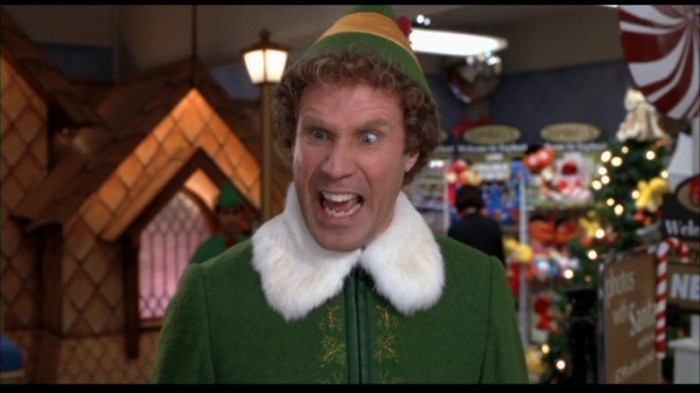
Elf-will-ferrell-1746096-800-450
There’s been some kerfuffle in Britain this year (2014) about Channel 4 losing the rights to show Elf and some genuine upset that this great Christmas film won’t bring the nation together.

This had completely baffled me. I’ve seen Elf. It was sort of OK in bits, but mostly a bit rubbish and in no way a great Christmas movie. A little Will Ferrell goes a long way.

I was going to write a piece slagging it off. But it seemed unfair. It’s been a long time since I saw it, and maybe I needed to look at it again. Maybe it was just me.

So I actually bought the DVD on my way home from work tonight, and I’ve just watched it, and I hate to say it…

It’s not me. It’s you.

I wrote everything from the bit where I say, “THIS IS THE BIT WHERE IT STARTS”, until the bit where I say “I HAVE A HEART OF STONE. THIS FILM IS ABYSMAL”, while I watched the film, and everything else afterwards.

THIS IS THE BIT WHERE IT STARTS…

It starts so well. Bob Newhart is so good and droll as a narrator at the beginning. The titles are just like a 1960s Christmas movie, all story book pages and charming animation.

And then it falls off a cliff.

First we have Ed Asner as Father Christmas, who leaves his sack unattended in an orphanage and fails to see a baby crawling inside. Asner is looking positively sinister. It’s hard enough anyway to sell the idea of a sort of benevolent burglar who slides down your chimney, creeps around your living room, and eats your food to kids without this sort of nonsense. I don’t want a sinister Santa, unless he’s Billy Bob Thornton.

We go back to the North Pole, to find elves dancing like Irish people in Titanic. And then Buddy the baby crawls out of the sack.

So Santa Claus abducted a baby and then decided to give it to an elf? That’s pretty dark stuff. I mean, yes, initially it was by accident, but if I find a child in the back of my car I don’t get to take it home with me and hand it to one of my slaves to raise.

And this is Father Christmas. One of the things we know about Father Christmas is that he knows where every child lives. He knows where that baby should be. It’s not up to him to second-guess the local adoption authorities.

And I’ll tell you this, that child would be better off with human parents, where he’ll fit in, instead of living like a freakish giant. What with this and the exploitation of Rudolph, lovable old Father Christmas is starting to look like a terrible sod.

Now the first clanger. Newhart the Elf has just told Buddy (Will Ferrell) that some kids don’t believe in Santa Claus. This is a massively stupid move. It’s fine for a movie aimed just at adults (not an “adult” movie – that would be obscene), but young kids are watching this. This is like that John Lewis ad where they showed parents hiding toys in the attic. This is not the place to open up a few cracks in children’s innocence. Leave that to the little bleeders in school.

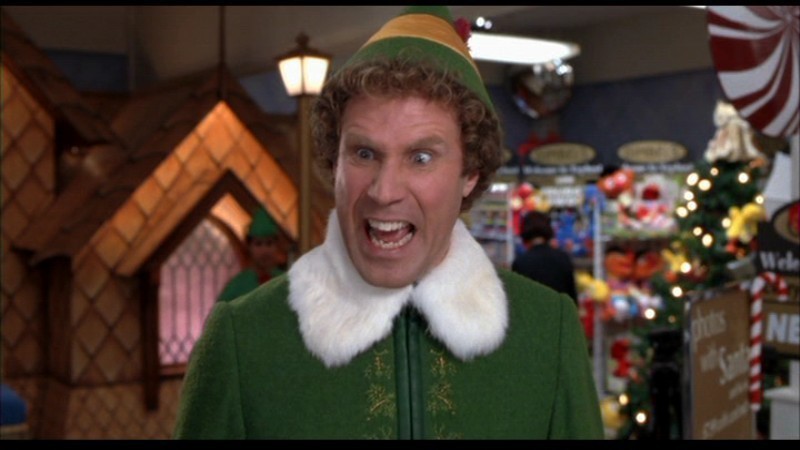
And speaking of innocence, Will Ferrell is supposed to look guilelessly innocent. He does not. He looks creepy. Even if he had the correct CRB documentation, I wouldn’t let him within 50 feet of my children.

Anyway, back to the story, Buddy overhears some elves talking about how slow and useless he is and discovers he is a human, and not an elf. It is comparable with the great Steve Martin scene in The Jerk where he discovers that he’s been adopted by a black family and that he’s always going to stay white. And the comparison is this: that was funny and this is not.

And now the killer. Newhart the Elf tells Buddy all about his life and how his mother put him up for adoption and then died, hands him a photo of the deadbeat dad who knocked his mother up, and then tells him where his dad works.

THEY’VE KNOWN THIS STUFF ALL ALONG. That is what the Americans call a “dick move”.

It’s OK, though, because Santa tells Buddy his dad is on the Naughty List, and maybe now he needs someone to show him some Christmas spirit to redeem him. YEAH, SANTA, OR MAYBE YOU SHOULD HAVE GIVEN HIM HIS OWN CHILD THIRTY YEARS AGO AND HE’D HAVE BECOME A DECENT HUMAN BEING AT THAT POINT.

So Buddy then has to walk from the North Pole to New York. Bear in mind that Santa Claus has a method of transportation which can criss cross the globe in one night, dropping presents off at most Christian family homes and some Jewish homes where they don’t keep kosher. He could have put the kettle on, dropped Buddy in New York, and been back before it had boiled. Santa Claus is a total swine in this film.

Finally, an unqualified success. Buddy the Elf wandering around New York. I see what they’re doing now. This is going to be a great adult comedy, a satire on selfishness and consumerism. It’s not for children after all.

He’s met his father (James Caan), who does some sort of job where he has to upset nuns, and who doesn’t believe he’s his son, and now he’s wandering around a department store.

Oh, God, I think this slapstick is actually aimed at children, but the tone is all over the place. There’s even a joke about porno cinemas (“Mummy, what’s a peep show”).

Buddy has just met Zooey Deschanel. She is clearly going to be the love interest, although she is about 15 years younger than him.
Elf

hqdefault

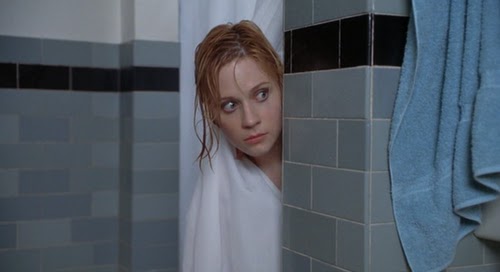
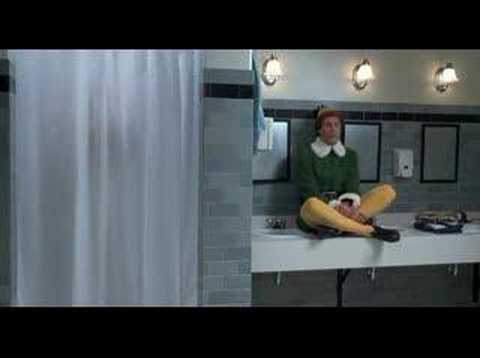
Ugh, she is in the shower, while he’s sitting in the bathroom. It’s meant to be sweet, but it’s CREEPY.

Another funny scene, where Buddy confronts the store Santa, and exposes him as a fake in a scuffle. But then again, AT WHOM IS THIS FILM AIMED? Is it children? Then don’t let them see behind the curtain. If a child questions the existence of Santa because of this film, or works out that the Father Christmas in the local department store isn’t real, then it’s appalling and, probably, counter-productive.

After the scuffle, James Caan bails Buddy out of prison, does a DNA test, and takes him to meet his wife and other son. At this point, Buddy explains about the four major food groups – candy, candy canes, candy corns and syrup. I am going to come back to this later and you are going to think about how clever I am. He captivates the wife, because this is a film and not real life. In real life, the wife would wave goodbye to Buddy and tell the father he is never to bring that freak into the house again.

James Caan’s boss just told him to do a job on Christmas Eve, and he’s said that’s OK. I reckon that’ll be important later.

Buddy takes part in a snowball fight with his half-brother and then finds out what a terrible man his dad really is. Apparently he works really hard. That is what a terrible man is in this film.

The half-brother tells Buddy to ask Zooey Deschanel out and Zooey Deschanel says yes, even though Buddy is the shower-room pervert and wears tights, so she can probably see EVERYTHING. This is the most ridiculous thing about the whole film. Zooey Deschanel could have her pick because she is Zooey Deschanel.

Buddy gets dressed in normal man clothes to visit his dad in his office and finds out what his dad does for a living – it turns out it’s something to do with children’s books. Children’s books and nun disappointing. This is really clever irony, because he’s actually terrible with children.

I’ve been hoping that at some point Buddy is going to stop being really irritating, but it’s not going to happen, is it? This is for two reasons:

1) Because he is cloying and juvenile and has a high-pitched voice which goes through me.
2) Because he is played by Will Ferrell. Will Ferrell is like Marmite. A brown smear.

Zooey Deschanel goes on a montage with Buddy, and finds him charming. Everything is great for Buddy, but then he turns up at a meeting on Christmas Eve by his father, insults a dwarf by calling him an elf, and is disowned, just in time for the end of the second act.

Buddy runs away. His half-brother goes across town to his father’s office, and walks into a pitch meeting his father is giving to his own boss just to tell him his 30-year-old adult son has gone missing.

The boss is all, “Look, kid, you’ll have to wait five minutes. I’ve just flown here on Christmas Eve to hear this stuff.”

And this leads James Caan to quit his job – ON CHRISTMAS EVE – for the sake of five minutes. Because nothing tells your family you love them more than making yourself voluntarily unemployed from your well-paid job ON CHRISTMAS FLIPPING EVE.

Buddy ends up on a bridge, staring out at the sky, just like Jimmy Stewart in It’s A Wonderful Life, while James Caan and the boy sort of wander about the place looking for him, until he spots Santa’s sleigh in trouble.

Buddy finds Santa, whose engine has fallen off his sleigh. It turns out there’s just no Christmas spirit any more, and Christmas spirit is what powers his sleigh. This is all well and good, but he’s got at least eight reindeer tethered to the front of his sleigh. If Christmas spirit is what powers the sleigh, why does he need the reindeer? This makes absolutely no sense.

In fact, I’m starting to think that this entire film is the brainchild of Richard Dawkins and his ceaseless efforts to prevent children from having any sort of imagination.

For example, a crowd and media descend on Central Park, where the sleigh has crash landed. And the TV reporter is chuckling at the idea that it might be Santa. I DON’T UNDERSTAND THIS AT ALL. This is a world in which Father Christmas delivers presents. Why do adults not believe in him? Where do they think the presents come from?

Anyway, coincidentally, Buddy and his father and brother find the engine at the same time, and have an emotional reunion, which given he’s only been missing three minutes seems a bit excessive. I have longer toilet breaks in work and I don’t even get a sarcastic round of applause when I return.

Santa tells them they need more Christmas spirit, so some stuff happens and there are all sorts of coincidences and, to build up this spirit, Zooey Deschanel makes everybody sing Santa Claus Is Coming To Town, which is silly, as it’s been established that he’s already there, but there you go. And Buddy’s family join in, followed by the rest of the crowd, and eventually ALL OF NEW YORK, even the atheists and the Muslims, presumably. But only one person isn’t singing.

That’s right, it’s James Caan. But when he sings the sleigh flies properly and that’s all it needed. And all the children get their presents. But only one each, according to Santa’s book.

Then Zooey Deschanel and Buddy spend Christmas Day with James Caan and his family and she sings Auld Lang Syne, for some unaccountable reason. Maybe she’s rehearsing for the following week, I don’t know.

And then Newhart the Elf comes back and tells us how they all lived happily ever after, and you’d need a heart of stone not to be moved.

I HAVE A HEART OF STONE. THIS FILM IS ABYSMAL.

It has the rigid journey of a sat nav and the emotional heft of a Steven Moffat Doctor Who episode.

And that is because it is so relentlessly sweet, like the four food groups I mentioned earlier. Because a good Christmas film needs grit. You have to earn that happy ending.

Look at A Christmas Carol. Scrooge is a monster. But he’s laid low by the four ghosts, utterly destroyed, so that when he’s redeemed it means something, it has weight.

Look at It’s A Wonderful Life. When George Bailey is on that bridge, he’s suicidal. It’s jet black. His life has failed. His business has failed. Mr Potter is going to destroy his town.

That syrupy ending, where the people of Bedford Falls come to his aid, and he has his family about him is earned. It means something.

But when Buddy the elf is on his bridge, it means nothing. He’s been rejected by a man he didn’t even know existed until about three days before. He’s still got a dad who loves him in the North Pole. Boo-flipping-hoo. He’s only been missing half an hour.

I’m not saying it’s the worst Christmas film ever. Clearly it isn’t. That’s Home Alone 2, which is the movie equivalent of being given exactly the same present two years on the trot, but to make up for it they’ve included some Donald Trump.

But it is not a great Christmas film. If you gave a computer a copy of Screenplay by Syd Field, a picture of a gurning Will Ferrell, a book of fart jokes, and the Phil Spector Christmas album, it would come up with exactly the same script as Elf.

It’s by-the-numbers, cod-sentimental, cynical-yet-syrupy guff. And I’m GLAD it’s not on Channel 4 this weekend. Watch a good Christmas film instead.

German Market Man

Here is a sort of repost of a Friday Interview from my old blog, back when I called myself Graham Bandage for complicated reasons. It is quite topical as long as it is still December, but before Christmas, when you are reading it.

In the latest of our series of interviews, Graham Bandage talks to Andrew Andrews, a man who went from being a humble market trader to one of the richest men in Britain.

Graham Bandage: Andrew Andrews, you’ve got a shedload of money.

Andrew Andrews: I should say so. Although I must say, I don’t keep my money IN a shed. Banks are safer and more convenient.

GB: It’s a shame, in a way. Imagine having a big load of money in your shed. That’d be ace.

AA: Can we move on?

GB: Yeah, I suppose. How did you make your money?

AA: Have you ever been to one of those German markets?

GB: Oh, yes. There are loads of them. I like them because they sell bread. But it’s not ordinary bread that you’d get from a shop. It’s extra-special bread that costs £10. Also sausages.

AA: That’s right. You can’t move for German markets in our city centres at this time of year. Gluhwein-crazed drunks stabbing each other. Teenagers off their faces on gingerbread. Bits of rope, the lot.

GB: I know you’re very rich and everything, but what’s your point?

AA: So what was happening in Germany?

GB: Eh?

AA: While all the German traders are over here?

GB: Eh?

AA: I flew over to Hamburg, and there were loads of Germans wandering around the market squares saying, “Was?” and other German words denoting confusion.

GB: Why?

AA: Because there were no stalls. All the German market traders were over in Britain charging £8 for a hot dog. I could see a gap in the market.

GB: Well, just a gap.

AA: What?

GB: There’s no market. Your gap is essentially THE market. You’ve got a market-sized gap in the market.

AA: Anyway, I sent a load of English market traders over to Germany.

GB: How did that go down?

AA: Like a storm.

GB: Did you do the full experience?

AA: Oh yes, tarpaulin, wire coathangers, milk crates, the lot.

GB: That sounds great.

AA: Those Germans just couldn’t get enough of our teatowels and “genuine” Paddington DVDs. And at £47 a pop, who could blame them?

GB: So that’s how you made all your money.

AA: Oh, no, while I was over there I bought a Eurolottery ticket. Won £45m.

GB: Andrew Andrews, thank you.

The Absence Of Godzilla

YOU’VE probably heard of Godzilla. Big green lizardy thing, stomps around a lot, doesn’t like buildings. I think he likes big packets of Chewits. I’m not entirely sure, I might be getting him mixed up with an advert.

Anyway, I’m going to ask you to employ all your empathic skills for a small exercise. Imagine being a person.

Doing that? Good. Now imagine being a person living in a city. More of a stretch if you live in the countryside, admittedly, but bear with me.

Still with me? Good, OK, now imagine being a person living in the city in which Godzilla is rampaging about the place, knocking down buildings, toppling things on other people, etc. Explosions, bricks, the lot. Would you be frightened? I know it’s not really happening, but this is an empathic exercise.

Now imagine Godzilla just stops and vanishes. There’s rubble all over the place, yes. Buildings on fire, Chewits wrappers everywhere – I don’t know, I’m not an expert in Japanese schlock culture – but no more Godzilla. Is that better?

I mean it’s not ideal. There’s still bits of building crumbling and some people are going to get hurt because of the after shocks. Ideally all the buildings would be back in place before teatime.

But the fact Godzilla has gone is an improvement in your life, isn’t it? A huge improvement, yes?

Good. Now imagine there are some people living in the next city while Godzilla’s rampaging about making a terrible nuisance of himself. Or herself. I don’t know, etc. And they’re looking at the devastation.

And an amazing scientist steps forward and says, “Look, everybody, I have created an amazing teleportation device. It will send Godzilla to THE MOON where he can’t do anybody any harm, apart from, perhaps, The Clangers. Isn’t it amazing?”

And all the people in the next city continue to look at the devastation and feel terrible as all the casualties mount up. And they turn to the amazing scientist and they say, “No.”

“But what?” says the amazing scientist.

“It’s no good just getting rid of Godzilla,” say the people in the next city. “They need all the buildings back as they were. EXACTLY as they were. Haven’t you got an amazing teleportation and immediate restoration of destroyed buildings back to their pristine condition device?”

“No, I mean, I could probably make one, but it’ll take years – FIVE OR POSSIBLY TEN YEARS,” says the amazing scientist.

“Right,” say the people in the next city. “Do that, then.”

“Can’t I just get rid of Godzilla for now, and sort out the rest later?”

“No,” say the people in the next city. “That does not fulfil all of our criteria.”

“But there won’t be any buildings left by then, and all the people will be trampled on. Go on, let me do it.”

“No,” say the people in the next city. “Not good enough. BYE!”

That was a good exercise, wasn’t it, children?

On an entirely different subject, I am increasingly despairing of middle class left-wingers who are refusing to back Labour at the next election, because “They’re just like the Tories.”

If you’re a middle class left-winger who’s tempted to abandon Labour at this point, ask yourself these questions: “Which party is more likely to redistribute wealth from the poorest to the richest, Labour or the Tories? Which party is more likely to privatise the NHS? Which party is more likely to cut the Welfare State right down to the bone?”

Ask yourself which party you’d rather have in charge. Then ask yourself if you can be self-indulgent enough to back a party which will take votes from Labour, and make it more likely for the Tories to get back in. And remember, it’s all right for you if you’re a middle class person, because you’re insulated from their excesses.

No, Labour is not a perfect solution to the vandalism of Tory austerity. And yes, they will come up with stupid Daily Mail reader-grabbing ideas like a Hippocratic oath for teachers.

But they won’t make it any worse for the people who need the most help. And sometimes that’s the best for which you can hope.

And in time we’ll be able to rebuild. But we can’t do that if the Tories are rampaging about, with Farage riding on their backs.

Just imagine what the Tories would do emboldened by a second term of office, on the back of the destruction they’ve already wrought on the post-War settlement.

And then don’t come to me the day after the General Election, with your Green badge, or your National Health Party rosette, and say, “It’s not my fault. I didn’t vote for Godzilla.”

Falling Out

GIVEN that the Scottish independence referendum is less than a week away, undoubtedly you’re all wondering what it feels like to be a leftish English middle-aged man at the moment.

Unfortunately, I am unable to carry out much in the way of polling beyond a very small sample of one, but I will do my best to enlighten you.

Several of you will tell me I am wrong, but, if anything, that will only prove my thesis. All I can say is that it is a good thing that I am unswerving in my opinion and always right.

So…

It is as if your friend has gone off with somebody you two had always agreed was a bad ‘un, hanging around with a bad crowd. You know the type.

So you take her to the pub, and you say to her: “I can’t believe you’ve gone off with him, you know what his sort is like.”

But she patiently explains to you that your fears are groundless. “Oh, but he’s not like all the others. Not deep down. He’s different,” she trills.

But you know, deep down, that’s bollocks. So you end up arguing about it because you love your friend. But she’s in love, so there’s naff all you can do about it.

And in the end you fall out over this scoundrel, who you hope will treat her right, but know – absolutely know – is a bad ‘un.

Years later, you see her in the street, bearing four rings she didn’t have before, two on her finger, and two under her eyes. And you ask her how she is, and she says, “Oh, fine, fine…”

And you start talking again, but only to say hello in the street. Maybe you bump into each other at parties, but that’s all. You’re never proper friends again.

That’s what it feels like.

COLUMN: December 19, 2013

I HAVE been thinking a lot about Christmas songs. I am not sure why – perhaps it’s the time of year.

We have had to suspend the normal rules of critical judgement for Christmas songs in the past, and let any old nonsense through to avoid the charge of being a Scrooge-like figure.

But it is time to make a stand for logic and good sense. For example, Wizzard’s I Wish It Could Be Christmas Every Day is no basis for the organisation of a society.

Roy Wood is the Russell Brand of Christmas, fine on sentiment, but crushingly vague on the detail of how such a utopia would be organised.

Yes, it sounds idyllic, but having Christmas every day would knock the glitter off, rendering Yuletide as unremarkable as brushing one’s teeth.

And at some point somebody would have to go out to work to pay for the constant daily parade of presents, turkey, etc. And where would he or she find the goods if all the shops are shut because it’s Christmas?

Then we have Cliff Richard’s Mistletoe And Wine. Cliff Richard, of all people, called upon to encapsulate the spirit of Christmas in song, sings about getting drunk and snogging somebody at a party, and we are all expected to accept this.

Let us skip lightly over the potential irritant of jingling all the way throughout a journey – I have endured enough trips twitching every time the bus hits a bump in the road because somebody is leaning against the bell – and alight upon an even worse Christmas song.

We Wish You A Merry Christmas is a big teeth-clenchingly bad bag of wrong. I have no idea how it was published. I don’t know if songwriters have editors – and I can’t be bothered looking it up on Google – but let’s imagine they do. And here I am imagining it.

THE BOARDROOM OF THE SMASHING SONGWRITING CO.
MD: Figgis, this is a big teeth-clenchingly bad bag of wrong. What were you thinking?
FIGGIS: Well, what I was thinking was, it’s nice to wish people a Merry Christmas and Happy New Year, isn’t it? And not just them but also their kin. And repetition really rams that message home.
MD: Their king?
FIGGIS: No, kin. But I can see why you might think that.
MD: Go back and try again.
TWO WEEKS LATER…
FIGGIS: Finished! What do you reckon, MD?
MD: “Bring out some figgy pudding?! We won’t go until we get some?!” That’s not festive.
FIGGIS: Figgy pudding’s quite festive.
MD: It’s blackmail. It’s as bad as that “trick or treat” scam you devised to sell sweets. Apart from that, how likely are people to have a Christmas pudding on the go the week before the 25th?
FIGGIS: Shall I scrap it?
MD: No, we’ll have to release it and hope nobody notices how terrible and repetitive the lyrics are… Now, how are you getting on with that “Happy Birthday To You” song?

But the most irritating song of all is Ding Dong Merrily On High. It’s not the fault of the song – which I have to admit is one of the best pieces about bells ringing and angels wafting about the place in Heaven – but the fault of you lot.

It’s the bit which goes: “E’en so here below, below/ Let steeple bells be swungen./ And i-o, i-o, i-o/ By priests and people sungen.”

I sang in the choir at school. For some reason I had decided that having glasses, a lisp, poor spatial awareness, and an inability to kick a football in a straight line did not make me enough of a target for the sort of boy who believed knowing the name of the Prime Minister was effeminate and was good at punching.

And so I was taught – CORRECTLY – that the pronunciation of “i-o” rhymes with “below”.

I have tried singing the line extra loudly, at the various carol services and concerts a man with children attends, in an attempt to change hearts and minds. “It’s EE-O,” my voice cries out,

“You’re doing it all wrong.” But it has never worked.

So, I have written this column for four years, and if there is one thought I want you to take away from my body of work it is this: Ding Dong Merrily On High is not a song sung by dwarfs on their way to work.

I wish you a Merry Christmas, and a Happy New Year. Once.

COLUMN: December 12, 2013

I’VE wondered in recent years how high street printers manage to stay afloat, given that everybody has printers at home.

After all, photo development shops were driven out of business by people’s new- found preference for taking 97 digital pictures at a single event and then never looking at them, rather than for taking 12 and putting them in an easily accessible album.

Then I had to produce the order of service for my mother’s recent funeral, and all became shatteringly clear.

Home printers are the handiwork of the devil. They are deceptively expensive, unreliable, and messy. Like Marouane Fellaini. It would have been quicker to use a monk.

As it happened, I had bought a new printer the day before my mum died. The protracted nature of its installation was the main reason why I could not visit her that day. But that is a mere eggcupful of warm water in a Jacuzzi of regrets.

I was quite pleased by the purchase initially – it seemed a bargain for a wireless, full-colour printer with scanner and, I don’t know, teasmade, probably. But that did not take into account that printer manufacturers are the Ryanair of IT.

– “That’ll be £79, sir.”

– “That’s very reasonable.”

– “Now, will you be requiring ink…?”

– “Um, yes. I was sort of planning to use it.”

– “Of course, sir. Here is a small pack of ink cartridges. That will be A MILLION BILLION POUNDS.”

By the time I left the shop, my wallet was actually hysterical. “Leave me behind,” it said. “I cannot go on. Save yourself.”

I took the device home and began the long process of persuading a printer specifically designed to talk to computers wirelessly to communicate with a computer specifically designed to talk to printers wirelessly. It should have been easy. It was not. I didn’t need a manual, I needed a counsellor from Relate.

Eventually, my computer informed me all the necessary drivers were installed and it was ready to set up my printer. All I needed to do was, for this initial installation, connect the printer to the computer with a USB cable.

“Phew!” I thought. “Thank flip for that. I thought this would never end.” I looked around for the cable. It wasn’t next to me. I looked in the box. It wasn’t in the box. I looked at the list of contents of the box. It wasn’t even on the list of contents.

The printer manufacturers intentionally had not included a piece of kit absolutely necessary to setting the printer up. I suppose I was lucky they had included a power cable, or the actual printer itself.

I went to see if I had the necessary USB cable, for I am a man in the year 2013. I have more USB leads than I have pairs of underpants. My drawer looks like a bag of liquorice bootlaces. Did I have the specific lead? Of course not.

Eventually I found a complicated workaround on the internet, and my printer finally whirred into action. This is what counts as a victory in this day and age.

Following my mother’s death, I was going through her effects – effects being what possessions become after death, apparently – and in a box of stuff I found the very USB cable I had needed. A cosmic joke from my mum.

I laughed and took it home. It was bound to come in handy at some point. You know printers . . .

A few days later – the day before the funeral – I had to print out the order of service, and help my brother tidy my mother’s flat before the family descended the following day.

My mum used to produce orders of service for all family members’ funerals, and I thought it would be appropriate to do hers on her own printer.

I flipped open my laptop, which detected her printer immediately. Good, I thought, it’s about time something worked out. I sent a test page. It didn’t print.

“Please install the printer driver,” the computer asked. “Here we go again,” I said.

I did so.

It went on. “To complete the installation, please connect the printer to your computer using the USB cable provided.”

Oh, I thought . . .

And through the quiet of the flat echoed the laughter of my mother.

COLUMN: November 28, 2013

I USUALLY write about minor calamities which have recently been inflicted upon me, most often by myself – encounters with disappointing soup, mysterious doughnuts on my front door, being trapped in a revolving door with somebody who doesn’t know how to use a revolving door, that sort of thing.

And I usually manage to string them out to 750 words so that there is not a blank space on this page, or, even worse, a column by one of my colleagues.

But I have had a major calamity inflicted upon me this week, and I find myself slightly defeated, and not entirely sure if writing about it is appropriate.

My mum died.

Writing that down in bald terms seems very odd, and provokes the same sort of puzzlement in me as if I had written “My shoes are made of olives” or “My unicorn is called Frank” or “They still call themselves Boyzone.”

It happened very suddenly, and it is still too big a concept with which to deal. Although, after the shock, I expect it is much the same for everybody when they lose their mothers, the same sort of feeling as on the first day of school when your mother lets go of your hand and you are led away by a smiling teacher with the knowledge that for the first time you are on your own.

So I will concentrate on small things. Family and friends were gathered at my mum’s on Monday, the day she died, pottering about and making tea in that strange atmosphere of tears and silence and laughter and “This is typical of her” comments, which envelops such occasions.

All of it was undercut with the knowledge that she was still “there”, in the next room.

And then the undertakers came and we sat together in the living room – the room of the living – while they prepared my mother’s dignified exit. It was so quiet, save for the odd gulp and muffled sob, as we sat and thought about her…

WOOF WOOF WOOF! AROOOOOO! WOOF WOOF WOOF!

“Sorry,” said my brother. And he switched off his phone.

We settled back in to contemplation.

AWOOOOOO-GA! HONK! HONK!

“Sorry,” said a friend of my mother. And she switched off her phone.

We settled again, and waited for the next one.

And so it was, that over the next 10 minutes there was an unwitting competition between the mourners gathered as to who had the most inappropriate ringtone for the occasion – twangs of arrows ranked up against monkey chatter, fanfares against farts.

I cannot swear that I was not laughing like an 11-year-old schoolboy, so I will not.

It occurred to me that mobile phones usually have an “airplane” mode, which quickly switches off wireless connections to prevent somebody tagging all their friends on Facebook and causing a plane to crash.

So why can they not also have a “funeral” mode, which replaces Outkast’s Hey Ya, cockerels crowing, or the sound young boys can make with a wet palm and their armpits, with a funeral march, Pie Jesu from Faure’s Requiem, or bird song? If they can auto-correct spelling, they should be able to auto-correct ringtones.

I left her home and went for a stroll through my past. My mother had moved from the house where I grew up years ago, so I traced the route we used to walk every day from my primary school to my old home. I stood outside for a while.

I was tempted to knock and ask if I could come in, to stand in the vestibule one last time, but there is a fine line between mourning in an honest and raw way and being a weirdo.

So instead I walked through the park she loved. And suddenly I felt very old. A man too old, at 41, to have a mother.

But as I emerged from the park, near some halls of residence, a pizza delivery man carrying some leaflets approached me. “Scuse me, mate, do you know where I can leave these?”

He thought I was a student! I’m not old, I thought. “Sorry, I’m not a student,” I was about to say, slightly lifted.

Then he saw my face properly, for the first time in the twilight. He was horrified. “Sorry! I didn’t…” he said, and scurried off. The sod.

I said at the start I wondered if it was appropriate to write a column this week. But the fact is I refused to let my loyal fanbase down.

Even though she’s died. Bye, Mum. x

COLUMN: November 21, 2013

I DECIDED to get a taxi. I don’t know why. Perhaps I wished to see how the other half lives, flush as I was on payday. Perhaps I wanted to be like somebody on The Apprentice.

Or perhaps it was because of my reluctance to walk across town with a stinking cold, through rain so fine it could have been lazy fog.

In any case, I hailed a taxi and stepped inside. That was my first mistake.

Bent double, I explained where I wanted to go, ie home, where there is tea and always-disappointing Lemsip, and the cab leapt forward, like a sufficiently wound Evel Knievel toy.

It was at this point that I became suddenly grateful that I am not a smaller man. A smaller man, with shorter legs, would have been deposited on the floor of the cab.

But, luckily, I am a taller man, and I was merely flung into my seat with the force of a gangster’s henchman, insistent that I sit down. I hit my head on a speaker.

This was going to be an interesting journey, I thought. I did not want an interesting journey. I wanted a journey I could introduce to my mother.

He rounded a corner with a certain gusto. I can’t swear he didn’t do it on two wheels.

And so I did something I rarely do in taxis. I weighed up the risks and put my seatbelt on.

I looked around the cab, trying to keep calm as it nipped through a gap between two moving buses so tight that if it were any narrower it would have required the application of Vaseline.

That was no good. I noticed that the driver had a satnav and I am always uncomfortable when a taxi driver has a satnav, especially a Hackney cab driver.

Cab drivers are supposed to know where everywhere is. They just are. That is supposed to be part of their skillset, along with being able to listen to TalkSport radio for hours on end without climbing into a clock tower with a sniper’s rifle.

When I see a satnav in a Hackney cab, it’s as if Sir Chris Hoy has fetched up to the velodrome with his bike sporting a bell and stabilisers.

But the most unnerving thing was the silence, the constant silence. The driver did not speak. He had no radio on. He neither took nor made a phone call. He was driving like this and he wasn’t even distracted.

This was turning into a horror film. He was some sort of silent assassin. I didn’t even know if he had a face.

I didn’t want to die alone. I started tweeting.

– “My taxi driver is taking a broad brush, big picture approach to traffic laws.”

I received little sympathy. I might have died and people were just being sarcastic.

– “Remember that bit in Planes, Trains & Automobiles where Steve Martin hallucinates John Candy is the devil? That’s me and this driver.”

Still no sympathy. I put my phone away. I was on my own.

It was so bad, I was actually starting to wish I’d got the bus. It was my own fault for having ideas above my station.

If this is how the other half lives, they are welcome to it.

The driver ripped through a just-red light. Through the window I could see pedestrians pointing, probably at the twin trails of flames licking at the Tarmac behind the taxi.

My life started to flash before my eyes. I had to snap out of it – I needed my wits about me, this was no time to be bored.

I was close to home. “I might just make it,” I thought. My grip loosened slightly on the door moulding.

“Can you take the next left?” I asked. Could he? Oh, yes, and without even slowing down.

He stopped outside my house, as abruptly as he had started the journey; my seatbelt was the only thing that prevented me from being attached to the driver’s security screen like a Garfield toy.

I gave him the money, and ran my fingers through my even greyer hair. (I say I have grey hair, I prefer to think of it as platinum brown.)

He handed me my change. He wouldn’t have done that if he wasn’t going to let me go. I was safe, uninjured, apart, perhaps, from some seatbelt strap welts and the time I bit my cheek.

I’d made it. I was so relieved I flung open the door and leapt from the car.

And I twisted my ankle in the gutter.

COLUMN: November 14, 2013

IT HAS occurred to me that I do not actually like going out to eat.

I am not saying that I do not enjoy food. I do. Not a day goes by without me actually eating some – in fact, I’ve come to consider it an essential part of my day.

But the actual experience of eating out fills me with anxiety. And sometimes breadsticks.

And this is true whether it is an upscale restaurant, in which the menus do not feature the word “and” – for example, “pigeon, textures of cabbage, home- pickled onion, banana-flavour Toffo” – or if it is a restaurant in which the waiter calls you “guys”, or if it is a restaurant in which there are pictures of the food above the counter.

I do not mind the bit in the middle of eating out – the actual eating part. But I do have serious difficulties with the practice of waiters asking me how my meal is while I’m chewing the first mouthful. “I can’t possibly know,” I want to say, “I didn’t manage to get a sample of every piece of food on the plate onto my fork.”

I do not, of course, I merely mumble something while trying not to give a thumbs-up sign, and force it down my gullet in case there’s a follow-up question – “Do you like my hair?” or “Can you see this spot?”

Why they ask is baffling. It just seems needy. If there’s something wrong with my food the only way they are going to find out is if they receive a letter from my solicitor.

I am as likely to complain about the food as I am to twerk in the middle of the restaurant or David Dimbleby is to get an anatomically-incorrect scorpion tattoo on his shoulder, i.e. improbable but not impossible.

And when I have finished eating, I am even more uncomfortable. I just want to leave. I don’t want to sit and chat, stretching out coffee after coffee. I can do that somewhere else.

Perhaps it is a holdover from my childhood, when I was taught to move out of the way and let others pass, but I am always painfully aware that restaurants are businesses and that they need my table so that the waiter can ask new people what their meal is like.

But I am incapable of catching a waiter’s eye at this point, invisible like a ninja. I suppose I could call out for the bill, but who wants to be the sort of person who calls out “Waiter!” in a restaurant? It is a wafer-thin mint away from clicking one’s fingers.

So I sit there, jogging my knee and occasionally raising my hand until the planets come into alignment and I am in the line of sight of a waiter, and my ordeal is ended.

These days I have a new source of anxiety, ever since a time I dined alone, as I occasionally must. It’s difficult to get people to agree to eat with me for the reasons outlined above.

I was actually enjoying my meal. The waiter had left and it did not seem that he was going to come back. I was maybe three-quarters of the way through my plate, when a thought suddenly occurred to me. I wished I’d had that thought before my meal arrived, but these things happen from time to time.

I left my table and visited the place whence my thoughts had wandered. I probably spent a bit too long in there because they had a Dyson Airblade hand dryer and it was the first time I’d used one. “This is like massaging a ghost,” I thought.

But when I returned to my table, the waiter had cleared it. My plate was gone. I still had a sausage left! I’d been saving it.

“Would you like to see the dessert menu?” the waiter asked.

I don’t enjoy confrontation in a dining environment, but this was going too far.

“You took my sausage,” I blurted out. I would have phrased it differently, but I wasn’t thinking properly.

“Oh, I’m sorry, sir. I thought you’d finished,” he said.

“No!” I said “I was…” – I didn’t want to say I’d been saving it – “… resting. Who leaves a whole sausage?!”

“I could get you another one,” the waiter said. I imagined a situation in which the waiter returned from the kitchen, carrying a plate on which rested a single sausage, garnished with a sprig of curly parsley.

I said no. The damage had already been done. Now I can never leave the table during a meal again.