COLUMN: May 3, 2018

grocery-store-2619380_1920
This is what supermarkets look like when it isn’t Saturday morning

I DO not have a problem with pensioners. My grandmother was one, as was my mother. My father continues to be one. One day, I hope to join their ranks – probably when I am 75, the way things are going.

But I do not always understand pensioners. I had to go to a bank last week to conduct some business. Ideally I would have done it online, but I have very recently switched banks, and I chose the one that likes to say yes, not only to its customers but also, it turns out, to bad IT solutions.

Owing to a series of disappointing events, I was forced to go to the bank at lunchtime. Nobody goes to the bank at lunchtime by choice, because it’s lunchtime for bank employees too, which means that at the time of greatest demand, the supply of cashiers is at its lowest.

It is a little like having a soft play area that is open all year round apart from at weekends and during school holidays.

The point is, everybody knows that the very worst time to go to the bank is at lunchtime. It is the equivalent of driving at rush hour. If you could go to the bank at any other time at all, of course you would. It would be madness otherwise.

So when I turned up at the bank, expecting to see a queue of estate agents, clerks, and shop workers tapping their feet and wondering why a bank with seven cashier windows only had two open, I was surprised to be in a queue with nine out of ten people in it pensioners.

Now, before you send me abusive messages about having respect for my elders – which is refreshing at my age – just hear me out. Or read me out. Or hear somebody else reading me out.

I am not suggesting that pensioners are banned from bank queues at lunchtime. Their parents didn’t fight a war so that they would have to wait another hour before paying in a cheque. It is the right of every free-born British person to go to the bank between 12noon and 1pm, even if they’re in front of me and they’ve got 12 bags of one-penny and two-pence pieces.

But why, with the whole of the working day available to them, would they actually choose to go to the bank at 12.23pm on a Thursday?

Similarly, why would anybody choose to do their big supermarket shop on a Saturday morning? Shopping at a supermarket on Saturdays is a hellscape of anger and rancour and clashing trolleys and young children who know that life ought to be better than this, as they kick their legs and try to get out of their tiny seats to escape to anywhere other than there.

These wise children speak for all of us. And, yet, go to a supermarket on a Saturday morning and regard in amazement the number of people who remember rationing and BBC2 starting who have become involved in the melee.

These are people who could go to the supermarket at any time, even on Thursday after they’ve been to the bank, when the shelves are heaving with freshly replenished goods and more than one colour of toilet tissue. It is as baffling as those people without children and who do not work in the education system who choose to take time off during the school holidays.

Why would they voluntarily make their own lives more inconvenient, I wondered as I stood in the queue? I would like to say that I did not give the fact they were making my own life more inconvenient a moment’s thought, but that would make me a big fat liar.

“Ooh, it’s ridiculous,” said the elderly woman in front of me. All the women in front of me were elderly. “It’s chock-a-block. They should have more windows open.”

“Yes,” I said.

She continued, “It’s always like this at lunchtime.”

I felt my neck pop. I wanted to ask her, if she knew that, why she was there right then. Why didn’t she wait an hour? Why wasn’t she there an hour before?

But I didn’t, because I had finally worked it out. The reason she was there, the reason they were all there, was precisely because there would be loads of people around to complain to. To talk to.

And one day I’ll understand it properly. Probably when I am 75.
COLUMN: April 26, 2018

j-wo
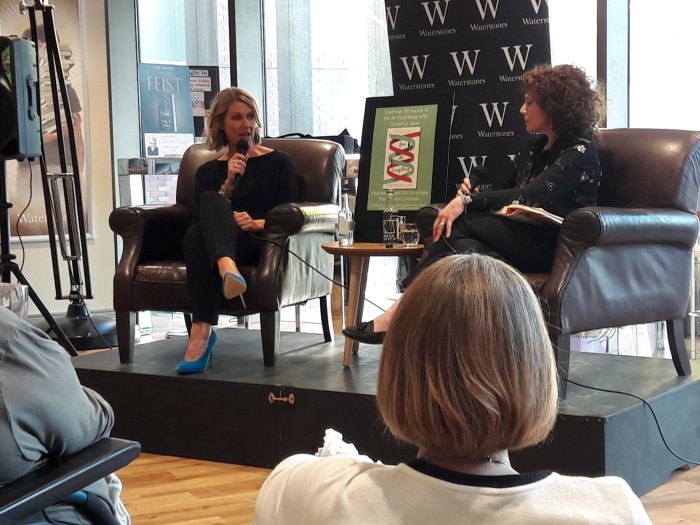
Catherine Isaac (left) at the launch of You Me Everything. I am not on this picture, but I was definitely there as I took it

I LOOKED natty, I don’t mind saying it. It is not every day one is lucky enough to go to a book launch, unless one is in some sort of book publicity business, and even then one would get the odd day off.

I was wearing a sharp grey suit, a shirt that did not look as if I had inherited it, and shoes so shiny I would have been able to see my face in them had I got the hang of my varifocals.

I wandered through town looking to all the world as if I parked my Lambretta somewhere and actually liked drinking espresso. I was even wearing sunglasses, which protected my eyes from the gleaming teeth of women beaming adoringly as I walked past them.

Nothing lasts forever. On turning the corner, I walked into a gathering of seagulls. I don’t know if you have ever done the same, but it is like entering a hostile pub.

We are all used, from childhood, to birds flying away when we enter their space. But pigeons and seagulls stand their ground these days and dare you to bump into them. So I picked my way through the crowd towards the bookshop where the launch was taking place. I wouldn’t bother them if they didn’t bother me, not in that suit.

But a yappy dog on one of Those Leads – a retractable, plausible deniability lead, a jogger’s tripwire – failed to read the room accurately. He unexpectedly bounded into the melange of seabirds and me, spooking at least one of us.

The gulls took flight around me, only my lack of wings preventing me from joining them. From a distance I would have looked as if I had tried to do one of those dove releases they have at ludicrously expensive weddings but on the cheap.

And, inevitably, one of them left its mark on my suit jacket. There was a Mr Whippy-style spatter pattern just over my left hip.

I rushed into the bookshop and into the customer toilet. The launch was 15 minutes away. I whipped my jacket off, grabbed some toilet paper, and turned on the tap to dampen it so I could dab at the affected area.

I had forgotten that you never turn on a strange tap in a hurry. A jet of cold water spurted out at crotch height and hit me at crotch height. In an instant, my problems had doubled.

I was grateful of the convention that there are no CCTV cameras inside customer toilets, as I am not sure how it would have looked as I thrust my crotch under the hand dryer while frantically attempting to remove seagull poo from a jacket in a toilet glaringly free of dry cleaning facilities.

The point is, it is very difficult to remove all traces of bird droppings from a grey suit. It is also very difficult to remove all suspicion of foul play caused by an unexpectedly exuberant cold tap from a grey suit. Basically, grey is the worst colour of suit you can wear if you want to get away with anything.

I decided the best way to proceed was to draw attention to the bird accident, and that way nobody would be looking at my crotch. Better to be a victim of misfortune than its father. I approached the author, an old and long-suffering friend and former boss. “A seagull pooed on me,” I explained, pointing at the residue with one hand and obscuring my other stricken area with the other.

Her eyes did the opposite of a look of surprise. “It’s supposed to be lucky,” she lied, as she bundled me out of the way to speak to other, less faeces-spattered guests.

My current boss arrived. “A seagull pooed on me,” I explained. “It’s supposed to be lucky,” she also lied, on her way to her seat. They must teach it at Boss School.

A former colleague said, “Ooh, lucky!” when I told her. By that time I had had enough.

“How is this lucky? How? A bird pooed on me. That is the definition of unlucky. Even if I’m supposed to be lucky from the second it hit me, my next job is to remove bird plop from my clothes…”

I was warming to my theme, and gesticulating madly, my arms a blur. “That is not how luck works. And I should know because I’ve never had… What?”

“Gary,” she said. “Have you wet yourself?”

You Me Everything by Catherine Isaac is out now, price £12.99, unless you can get it cheaper. You probably can these days.

COLUMN: April 19, 2018

Clark Kent
A man wearing glasses. I am not saying I am like Superman. It is not for me to say that

FOR most of my life I have worn glasses. I think only the logistical difficulties prevented me from being born wearing them.

For the first nine years, my glasses were intended to make my virtually blind right eye work. And when they realised they would have better luck getting a post-Brexit economy to work, my doctors told me I did not need to wear them any more.

But I started wearing glasses again in my mid-20s, when I belatedly realised that I was having trouble seeing into the distance. Luckily I was a poor footballer in any case, so this was not important. The only time I ever had to see into the distance was every day when I was driving on the motorway.

And so I continued to wear glasses, ostensibly for distance vision, but, because I am a) lazy; b) prone to losing things; and c) too vain to wear a Larry Grayson-style spectacles chain, I only ever took them off for sleeping and showering. Even when I took them off I still found myself absent-mindedly pushing a phantom pair up the bridge of my nose.

All was well for the best part of 20 years. I would have eye tests every couple of years. Occasionally my prescription would be marginally strengthened, and I am not entirely sure it had to be. When the optician asks me if the first or second lens is better, I honestly do not know. I am convinced that sometimes I actually got worse glasses after an eye test than the ones I had before.

But recently I was reading an article on my phone and I realised I was squinting and holding the phone at arm’s length. I lifted my glasses. The text was blurred without glasses and considerably more blurred with the glasses.

“Oh, marvellous,” I thought. “It’s finally happened. First grey hairs, then my barber’s suggestion that he might trim my eyebrows, and now this. I need reading glasses. Next stage is excessive ear growth, then elasticated waist trousers, then a more than mild interest in advertisements publicising funeral insurance plans starring the worst actors over the age of 65.”

I shuffled along to the optician’s, a new one this time. Perhaps the difference between this one’s first and second lenses would be more apparent and I wouldn’t have to guess the answer. “How long has it been since your last eye test?” the optician asked me. It felt like going to Confession.

“About 18 months,” I said. He raised a quizzical eyebrow. “Oh,” he clearly thought, “That’s not very long. I’ve got one of those recreational eye test-takers they warned us about at opticians’ school.”

“That’s not very long,” he said.

“I’m having trouble reading while wearing glasses,” I said. “This is a new and unwelcome twist in the story of my eyesight.”

“You could just take them off,” the optician said, presumably unaware of his company’s keenness to flog me as many pairs of glasses as possible.

“I could, but I know I wouldn’t. Can’t I have varifocals?”

He acceded to my request and gave me a sheet of small type to read. With a particular lens strength, I could read it so well I forgot myself and added intonation and emphasis, like Richard Burton. It was almost a pity when the optician snatched it away.

My prescription was ascertained and I was sent off to a salesman to choose some trendy frames (there is no such thing as a trendy frame) and work out what sort of varifocals I would like. For there are four different levels of varifocal excellence, and the only difference I could see between them was the price.

I chose the second cheapest, my standard approach to all such choices, and waited a week for my glasses to be hewn out of the glasses mine, or however they make them.

I have been wearing them for a couple of weeks, and I can tell you this: varifocals take a lot of getting used to. For a start, you have to remember to move your eyes, rather than your head, when changing focus from one thing to another, making you look like an Eagle Eyes Action Man.

And walking downstairs is much more interesting, especially if, like me, you have vertigo. Adding the element of blurring to the experience makes descending a staircase as exciting as a roller coaster.

This is what it is like to be older. I can see that now. Literally.

COLUMN: April 12, 2018

tapas-703902_1280
This is not a meal

TAPAS is a tremendous concept. I don’t know if you speak the language but “tapas” is Spanish for “can’t divide the number of items on the plate between the number of people at the table”.

Before the tapas revolution came to this country it was terrible. You would go to a restaurant and choose, usually, three dishes, a starter, a main course, and a pudding. They were designed so that your starter would pique your appetite, but not leave you too full for a main course, and your main course would leave enough room for a pudding.

And then you would stagger out into the cold air, pleasantly full, or, at least, not feeling that if you got your skates on you could catch the chippy. Imagine how awful that was, that feeling of having been looked after.

It’s much better these days, now we have Taken Back Control. How dare those expert restaurateurs decide what makes up a balanced meal, when we are perfectly capable of choosing three different starters even though we have literally no idea how much will be on each plate?

For nobody has ever walked away from a tapas meal having endured the tyranny of eating the correct amount of food. They have always over-ordered, on the basis that it’s better to order too much than not enough, or under-ordered, because they remember what happened last time when they ordered too much.

And how great it is that this tapas experience is no longer confined to Spanish restaurants. Every restaurant that opens these days is a “small plates” enterprise, so now you can have no idea how much food to order across a much wider range of world cuisines.

Before the big roll-out, if you wanted to have an argument because one of your companions didn’t order croquetas on the basis that “we’re all sharing anyway, aren’t we, and I’ll just have one of the three croquetas that you, the person who really wanted croquetas, ordered”, you would have to go to a Spanish restaurant.

But now you can have an argument anywhere, and not just over croquetas. You can have seething resentment boiling over into passive-aggressive comments like “Somebody didn’t have any lunch, eh?” about falafels or the last siu mai dumpling.

And, because the food “comes out when it is ready”, you can enjoy the experience of sitting there unfed for half an hour while you watch your friends tucking into the pad Thai and albondigas they ordered, and then let them wait while you eat the three dishes you chose and which finally came after everybody else’s (small) plates were cleared away.

I know, I know. I have over-ordered sarcasm. The fact is I have no idea why small plates have become so popular in the catering industry. I can only assume that they’re cheaper to clean. It can’t be because the small plates experience is actually good.

Because the tapas experience was not designed for the restaurant business. Tapas or the Italian version cicchetti were for bars. You’d go on, essentially, a pub crawl around Barcelona or Venice and you’d have a drink, and you’d choose a plate of tapas to go with it.

One bar would specialise in seafood. Another would do the best patatas bravas for kilometres around. But it would be a snack to have with your cerveza or dry sherry. It’s the Mediterranean equivalent of having a packet of nuts ripped from one of those cardboard displays featuring a woman who is not dressed for a trip to Sainsbury’s.

Imagine opening a restaurant in Madrid based on the British pub snack experience. You would be shown to a table which smelled of lager-soaked towels and the gents’. Your (small) plates would be placed on beermats.

And then the food would emerge from the kitchen, “as it’s ready”. A waitress with a Chinese character neck tattoo saying “mum” would rip open a bag of cheese ‘n’ onion crisps and leave it in the middle of the table. Tooth-shattering pork scratchings would appear, if you were lucky. If it were a particularly fancy joint, a rubbery pickled egg, dripping with vinegar, would be delicately placed in a repurposed Worthington E-branded ashtray.

And then, 20 minutes after you’d finished these traditional British delicacies, and were thinking about the bill, out of the swinging doors would come the scampi-flavoured fries both you and the kitchen had forgotten about.

Actually, this might work. I must have a word with my bank manager.

COLUMN: April 5, 2018

salad-2850199_1920
That’s right. Leave that coriander over there in the corner, well away from me

IMAGINE if there were an ingredient that roughly seven out of eight people really liked or, at worst, were not really bothered about, but made roughly one out of eight people retch.

And imagine if this reaction by a minority were not about fussiness or an understandable dislike of, say, melons (98% water, 1% cucumber, 1% air freshener) or yoghurt (condensed sour milk). Imagine if it were caused by a genetic intolerance which makes the ingredient taste like soap or rusty nails or that feeling you have when Nigel Farage is on Question Time.

If you were a chef or supermarket home economist, you would think: “Well, honestly, Trevor, I don’t think this is worth the risk. You and I might like it, but a significant minority of consumers are going to feel like licking the side of a matchbox to get rid of the taste. And I mean the rough side, not the side that says England’s Glory, in case you were wondering, you massive pedant.”

That is how things would work in a sensible world, but this is not a sensible world. This is a world in which there are 17 different types of vending machine and none of them work. This is a world in which I – a man who travels to work on a bus and put a bookcase together back to front at the weekend – would beat the President of the United States in a game of Scrabble or even I Spy.

And this is a world in which people put coriander (or cilantro, if you’re American and can’t be bothered doing the research) into things.

Now, if you are one of those people who think coriander is the best thing since sliced bread, and, actually, sliced bread could indeed benefit from the introduction of chopped coriander into the dough at proving stage, you will not understand what the fuss is about.

I can see you there now, chomping through mounds of coriander, happy as Larry (that’s Lawrence Berkowitz, four-time winner of the Man V Cilantro Challenge on the Cilantro Network). “What is wrong with lovely coriander?” you ask, mouth stuffed with the vile muck.

What is wrong with “lovely coriander” is that somewhere between 10% and 20% of the population have a genetic variation in our scent receptors that makes it taste like soap. Not my words, but the words of Science.

Sure, there are people out there who are fussy and don’t like coriander, like those people who don’t like garlic because it’s foreign. And they could train their palate to like coriander. And good luck to them.

But there is a significant minority of people, about one in eight of us, who will never be able to enjoy coriander because it tastes as if somebody has spread some Swarfega on our garlic naan.

That is a significant minority of people who can have their dinner completely ruined without notice. And it’s all very well saying that these poor, if incredibly attractive and witty, people can just avoid coriander, but it’s not as simple as that. Not everything is as blatantly labelled as carrot and coriander soup.

For coriander gets slipped into all sorts of stuff these days. It’s the Undercover Elephant of herbs. The coriander zealots think it improves everything, so they chuck it into soups, leaving you to assume it’s something safe like parsley until you slurp some, and salads, because the most diabolical place to hide some terrible leaves is among other harmless leaves.

This cannot be allowed to stand. We, the coriander intolerant, demand it. There needs to be clear labelling on packaging and menus, and not just in the list of ingredients. There needs to be a special sign. I recommend a logo featuring a big bar of soap, that should be plastered on the front of the packet.

This Soap Mark would be a warning to corianderphobes to stay away. And it would also be a signal to the sort of person who likes coriander. “Come in,” it would say. “You can’t move for herbs that taste like Fairy Liquid in here. Fill your boots.”

If anything, it would allow chefs and supermarket home economists to put even more coriander in things. Which is ideal, because there would be less lying around the place for the likes of me to worry about.

And if you say I’m overreacting, you are obviously not one of the chosen one-in-eight. And you should wash your mouth out with soap.

COLUMN: March 29, 2018

lasagna-605655_1280
A wholesome plate of lasagne, lasagne being the plural form of lasagna

I HAVE been learning Italian for some time, in my spare time, mostly because I am bloody minded.

“Oh, so you’re pulling us out of an economic and political union worth billions to our economy and which has kept peace in western Europe for 60 years because you heard somebody speaking Polish in your GP’s surgery? Fine, I am going to become even more European.”

And partly it is because I have Italian forebears, so I thought somehow that I would have the genetic ability to speak Italian and it would be easier. I could not have been more wrong, but once I start something I have to see it out relentlessly until the miserable end, no matter the cost.

However because I work hours which prevent me from going to night school and am an age which prevents me from going to day school, I have been learning on my own. This has one advantage – nobody ever gets to hear my Italian – and one disadvantage – nobody ever gets to hear my Italian.

This means I jump at the chance to try it out on people. A few months ago, a gentleman approached me at a railway station. “Excuse. I have need to go to Birmingham on the railroad,” he said, in a heavy accent. He could not have been more obviously Italian had he been sharply dressed and on a Vespa while stretching pizza dough with his knuckles.

“Lei è italiano?” I asked, formally. He nodded. This was my moment.

“Bravo, bravo!” I said. “Parlo italiano!” I knew exactly which platform he needed. “Ha bisogno di…” and then I stopped. I had forgotten the Italian word for “platform”. I had forgotten the Italian word for “four”. I had forgotten the Italian word for “to go”.

Dumbly I pointed at a gate. “There,” I said. I had forgotten the Italian word for “there”. “You. Go. There,” I said, like an English tourist in Torremolinos. It is hard to describe his disappointment at this turn of events. He looked like a child handed an empty box on Christmas Day as he shuffled off warily in the direction in which I had vaguely pointed him.

It made me redouble my efforts. Never again would I forget the Italian for “to go”.

And then, a couple of weeks ago, I found myself in an Italian restaurant with an Italian owner and Italian staff. And Italian food. “A gin and tonic, please,” my companion asked the waiter. He looked at her baffled, walked away, came back and said, “I can’t get you a gin and tonic. I can get you a Negroni.”

“He’s definitely Italian,” I said to her, as he left again. “You know what that means…”

“Don’t,” said my companion, a languages graduate who speaks French better than the French. “You know what will happen.”

“But…” She was right. They would be ruthless. “OK,” I said, “But I’m going to pronounce the names of the dishes properly.”

I slipped in the odd “grazie” to the waiter, but mostly I kept my promise to speak English.

And as we left, I did drop a “buonanotte, arrivederci” to the owner as he said goodnight. That was it. But as we reached the door, my companion said: “Oh, I’ve left my gloves.”

“I’LL GET THEM!” I said, tearing up the stairs. This was my chance. I knew the word for “gloves”. I entered the dining room. A waiter was clearing our table.

“Scusi,” I said, “Ho bisogno dei guanti della mia fidanzata.” A perfect, if stilted, Italian sentence fell from my lips. I think I heard a choir of angels, but it might have been the opera they were playing on the PA. It was a very Italian restaurant.

“Ah, ecco i guanti!” I said, spotting the gloves on the floor and picking them up.

“Parli italiano…?” the waiter asked. “Hell, yeah, I flipping parlo italiano” I thought. “Un po’ [a little],” I said, suavely, waving my hand.

“Buzz buzz banana tutti frutti lambrusco lambretta wibble, eh?” he continued. I think that’s what he said. “Buzz buzz Roma Colosseum macaroni La Dolce Vita Lena Zavaroni?”

I looked stunned for a moment, then guessed “Sì”, and I scarpered back downstairs.

“I just had my first conversation in Italian with an actual Italian,” I told my companion.

“You couldn’t help yourself, could you?” she said.

“No,” I said, “I’m bloody-minded.”

COLUMN: March 22, 2018

old-1184126_1280
One of the few right-hand drive car pictures available on the internet

I HAVEN’T driven for a few years, mostly because bus drivers seem to take a dim view of it.

But I intended to go to York for a couple of days, and, for reasons which need not concern you, it was not clear when my companion and I would be able to depart or have to return. That meant I had two choices: buy an open return train ticket or hire a car.

Given that I would have to take out a new mortgage to pay for the former, I decided to go for the latter.

I don’t know if you have ever had to hire a car before, but it is not an entirely straightforward process. First of all, the pricing structure makes budget airlines look refreshingly upfront.

On the website you are quoted an enticing price, you click on it, and then you are surrounded by the virtual equivalent of a cross between a heavy in hobnailed boots and the man from the Gladstone Brookes advert.

“Nice car you’ve chosen there, sir. Shame if anything… happened to it,” he says. Right, you say, and you click on another £30 windscreen insurance.

“But what if the car is stolen?” he says. “Do you really want to have to pay out the first £1,000?” No, I most certainly do not, you say, if I had £1,000 to spend on cars I’d buy a car, and you click on another £25 theft insurance.

Before you know it, your enticing price has put on four stones, stopped shaving, and started hanging underpants in your fridge.

But the second thing about hiring a car is that the hire firms are not entirely trustful of you. They don’t just let you turn up with the equivalent of a briefcase full of pound notes and drive off with one of their motors. They require your driving licence, the paper part of your driving licence, which is now online, and requires you to get a special code from the DVLA, your passport, and a utilities bill as proof of address.

In short, the hire firm I used is now more sure of my identity than I am. In long, it is extremely hard to source a utilities bill these days, as the utilities companies had successfully convinced me a few years ago to go for paperless billing. Also, in order to get that special code from the DVLA, you need to know your National Insurance number. And if you don’t know your National Insurance number…

Hiring a car, dear readers, is a quest with lots of little side missions. I had all this to contend with, and I still wasn’t entirely sure I could remember how to drive. But on the day of the pick-up, I walked confidently to the hiring station, through a formerly industrial area now being converted into Luxuryflatsville, my suitcase trundling behind me.

“Oh, brilliant,” I thought, passing a building site, as a flurry of snow came down. “My first driving experience for four years, and I’m driving in this.”

I put up my umbrella and walked on, but the snow stopped as quickly it started. I entered the car hire office and explained myself. I handed over my many forms of identification. “Oh, we don’t need that,” said the operative, handing me back the utility bill. “We don’t ask for them any more because everybody’s on paperless billing.” My eye twitched.

“Right, that’ll be £410,” he said. My stomach dropped. “What?” I said.

“Yeah, we take a £250 deposit.”

Why did they need a deposit? Did they think I would do a runner? Firstly, they know exactly who I am, even more than I do. And they know where I live. More than that, I’ve taken out insurance to cover theft.

Also, if I were going to do a runner, hiring a car two weeks in advance of getting out of Dodge is the most bizarre and inefficient way to do it.

It was all too much. I could see spots before my eyes. I rubbed them, but the spots were on my glasses. “Why hasn’t that snow melted?” I wondered.

I looked down and, after a moment’s calculation, realised that the snowstorm I had walked through was actually a fine spray of white paint from the building site. I was spattered head to foot like a plasterer’s radio.

The spattering is still on my umbrella and suitcase, a souvenir of the weekend taunting me.

This is why I never drive.

COLUMN: March 15, 2018

Pyalo7Uj
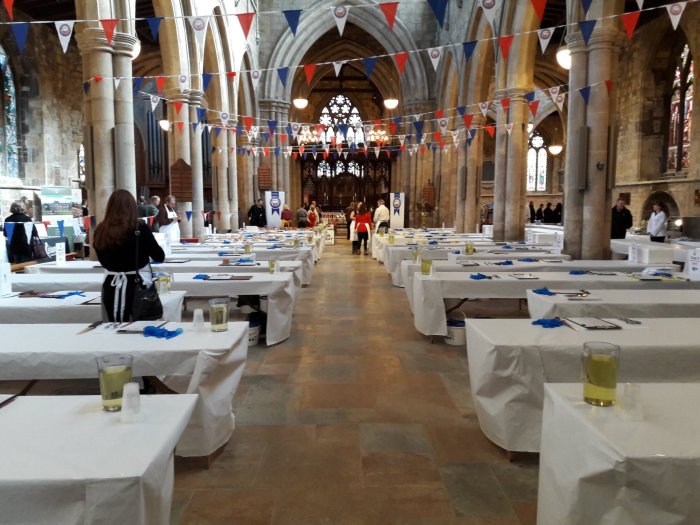
Inside St Mary’s, Melton Mowbray, for the British Pie Awards. There are relatively few pies on the tables at this stage

I LIKE a pie. While I do not really have the frame of somebody about whom it would be suggested that he be the main suspect in the Who Ate All The Pies? Mystery, I am happy to admit to have eaten at least some of the pies.

Nevertheless, until fairly recently, I would not have been considered an expert in pies. No longer. For the past couple of years, owing to a complicated series of unlikely events, I have been a judge at the British Pie Awards.

Whenever I tell people I am a judge at the British Pie Awards – and if you spend any more than 38 seconds with me, I will tell you this – they say one of two things.

The first is “What makes you an expert on pies, Gary, apart from the fact that you’ve clearly eaten a few?” I reply to this, “I am a judge at the British Pie Awards. That is what makes me an expert on pies.” I do not care that this is circular reasoning. Facts mean nothing these days.

The second is, “You lucky thing [sometimes they do not say ‘thing’]. That must be the best job in the world. All those pies. Pies are great. I hate you.”

And in many ways, they are correct. Pies are great and it might well be the best job in the world. But do not let yourself think it is an easy ride.

Let me explain by sweeping aside the Pie-on Curtain and taking you through what happens when you are a judge at the British Pie Awards.

You get off the train at Melton Mowbray and make your way to the beautiful St Mary’s Church. Melton Mowbray is a pretty town which tells you that it’s the home of pork pies and Stilton cheese about as often as I tell people I am a judge at the British Pie Awards.

You are provided with a white apron, and, after a short introduction which impresses upon you the seriousness of the task ahead, but includes a small number of pie-related jokes, you find your category table. You see, judges only pass judgement on one type of pie. It is not a pie free-for-all, or pastrymonium. If you’re on meat and potato, all you will eat that day is meat and potato pies.

And when you try the pies, it is not a matter of guzzling them like the Cookie Monster in Sesame Street. You have a partner judge who will also want to try the same pie – so you have to leave some behind – and a list of six criteria on which you mark the pies.

You have to take into account the appearance of the pie, the quality of the bake, the thickness (and doneness) of the pastry, the taste of the pastry, the quantity of filling, and the taste of the filling. Pencils are involved. Sometimes even esoteric arguments about how much pepper is too much pepper surface. You have to care about things about which you have never before cared.

And it is not like wine tasting, where you spit out the wine after you’ve tasted it. Obviously you could spit out the pie after you have eaten it, but that’s never going to happen. Call it Northern Conditioning.

The point is, it is pie-eating in a way you would never normally eat a pie. You eat a sliver of pastry and a morsel of, for example, steak and/or kidney, write down your scores, and move on.

And you do this roughly 25 times, so that by the end of your stint, you will have a lump of pastry and meat in your stomach about the size of three normal pies. Your centre of gravity will have altered in such a way that you cannot be pushed over, like a Weeble. And your body is crying out for some cabbage or, perhaps, a satsuma.

And the thing about competitions is that, well, not every entry is a winner. Let’s put it this way, you will come to understand just how easy it is – and how many ways there are – to mess up a pie.

So while it is indeed a great honour and I am very lucky to be a judge at the British Pie Awards, don’t think that it is all gravy.

Because if it were all gravy, it wouldn’t be the British Pie Awards. It would be the British Steak Bake Awards.

COLUMN: March 8, 2018

star-wars-medal-ceremony-1-216329-1280x0
It will never fail to amuse me that Star Wars ends with the heroes literally getting medals for being heroes

AWARDS season is in full swing at the moment. There are Oscars, Grammys, BAFTAs – you can’t walk down the street without somebody trying to give you a golden statuette or piece of engraved glass for Best Use Of Pavement.

Some might say enough is enough, but I say enough is not enough enough. If anything, we need more awards ceremonies. And why should we only celebrate the absolute best of things or pooh-pooh the absolute worst of things? Where are the awards for the not-bad-but-not-in-any-sense-good-either, the mediocre?

And that’s why this week this column is happy to unveil the Bainbridge Awards, a recognition, if not celebration, of the not quite good enough for bronze medals. If you wish to visualise these awards, they are a sort of pewter mug, with the handle being just that little bit too small for comfort, but not so much that you would feel you could complain about it.

The first Bainy, for Most Unhelpful Helpful Thing, goes to the man who invented the little X in the corner of pop-up ads on web pages to make them go away. That X is invaluable as long as A) you can see it; and B) your fingertip is tiny enough to be able to touch it without clicking on the ad. These two criteria are fulfilled only 62% of the time, which means, maths fans, that 38% of the time you accidentally click on an ad instead of getting rid of it.

And that means that if you accidentally click on an ad for bidets or garden rakes, you will be plagued forever more with ads for intimate hygiene or hoes, making anybody who wanders past your computer while you are at work wonder what the hell you have been doing with your spare time.

The second Bainy, for Most Inconvenient Convenient Thing, goes to the automatic car wash. Automatic car washes are the ideal solution for those people who want only 90% of the dirt on their cars to be removed, with the remaining 10% of the dirt used to smear or scratch the windows and the paintwork, and all done in the most terrifying way possible.

However, it is by far the least worst of methods of car washing. If you do it yourself it takes ages, you will look like you’re in a 1980s pop video, and somebody will ask you if you’ll do their car next, which is a joke so frequently employed that it has gone past cliché, beyond even banter, and into the dictionary as a standard neutral greeting, like “hello” or “good morning” but only ever to be used when meeting a person washing a car.

And if you go to a hand car wash, you have the lingering suspicion that you are somehow profiting from the 21st century slave trade. I mean, really, how can they possibly be paying all those eastern European men a living wage for £5 a go?

The third Bainy, For Sound Only Marginally Better Than Silence, goes to Smooth Radio. Smooth Radio is the aural equivalent of a rich tea biscuit, a boyfriend/girlfriend so inoffensive that you could introduce him/her to your mother and she would be relieved and at the same time wonder if she is ever going to have any grandchildren.

Smooth Radio is Route One radio – if the DJ tells you which acts are coming up in the next quarter of an hour, you know exactly which songs by those artists the station will play. Nothing unexpected has ever happened on Smooth Radio, not even the news.

But the least unexpected song by an artist to be played is pretty much always the artist’s biggest hit, and it’s their biggest hit because it’s one of their best songs. Stevie Wonder’s I Just Called To Say I Love You is the exception that proves the rule. Every time they play it on Smooth Radio.

And that is why Smooth Radio is allowed to exist and is played in hairdressers and doctors’ surgeries up and down the land. It plays neither challenging music nor bad music. Nobody ever rioted after listening to Smooth Radio.

Of course, there are more awards, but these appear crammed in at the end, the equivalent of the gongs for best sound engineering or best screenplay. The other winners of Better Than Nothing But Still By No Means Good are Pumpkin Cafes at railway stations, the British public transport system, and Labour’s Brexit policy.

See you next year!

COLUMN: March 1, 2018

red-rose-in-snow-3183739_1280
A railway track with some snow. The red rose is a red herring. It was just on the stock picture

IT WAS when a sudden jerk delivered my nose into the armpit of another man that I rued two things. The first was the lack of a law compelling all men in Great Britain to shower and use underarm deodorant before going to work in the morning.

And the second was the lack of a law compelling all train companies in Great Britain not to be absolutely bobbins when it’s a bit chilly out.

I apologised to the man, although, quite frankly, he should have apologised to me and everybody else within sniffing distance. A bing-bong bing-bonged, followed by a moment of crackle, and then the tones of a man who regularly does this, but has never been on a training course to do this. “Mumble mumble adverse weather conditions mumble mumble severe disruption mumble mumble more information.”

I translated the announcement, the gist of which was that the train company had not anticipated cold weather in February and how could we possibly expect it to get all its trains to work and honestly I should count myself lucky to be on this train.

But the announcement was not needed. We were all very aware of the situation. Two train-loads of people were on one load of train owing to a cancellation of the previous train. It was an intimate business, I can tell you.

The people with seats were maintaining a lack of eye contact with those standing. Partly this was a sense of embarrassment – a form of survivor’s guilt, perhaps – but mostly because it is difficult to look people in the eye when one’s line of sight is blocked by a stranger’s crotch six inches away.

And yet, crowded as it was, there were not enough people to make it unnecessary to grip onto a safety rail. However there were too many people to make it possible for everybody to grip a safety rail. It was the opposite of Goldilocks’ porridge. One sudden brake, and the carriage would have looked like a Guess Who? board after an earthquake.

Now I understand that this country is not Sweden or Norway, where heavy snow is constant over winter, and where it makes sense to spend vast amounts of money on making sure that people can commute without having to qualify for the Winter Olympics. We don’t have that much snow in this country, especially these days.

But this is a Northern European country. Between November and March it can be quite brisk out there. Sometimes you might even need a coat, unless you are a person in your twenties on a night out in a northern city. And sometimes the ground can get a little icy. Sometimes, in fact, it even snows. This is something that we can expect from winter.

And yet, our train companies are somehow allowed to get away with the fact that their rolling stock and infrastructure fail when the temperature drops to a level that is within the normal range of climate of this country.

They cannot be blamed for the weather, but they can be blamed for lack of preparedness. I work in newspapers. You’ve probably noticed. If there were a disaster out of my control that seriously compromised the production of the newspaper I make, I would fight fires and do what I could to get the paper out.

After that, my boss would say, “Well done. You rose to the occasion beautifully, Bainbridge. Have a bun. No, not one of the nice ones. Now, what plans do you have to make sure that, if this unexpected disaster happened again, we would get the paper out smoothly?”

And if this unexpected disaster happened again, and the production of the paper were similarly compromised, I would be out on my ear or bottom depending on how I landed. Doubtless you would find yourself in a similar position in your own job.

But if I were sacked and found myself working for a train company, the first thing I would do is ensure the trains worked even if the tracks were a bit frosty first thing. I would make sure that my trains worked ESPECIALLY during the times that it’s more dangerous for people to be travelling on the roads.

In short, I would ensure that only a shower of flaming meteors would prevent my trains from getting from A to B Parkway (that’s several miles from B).

And after that I would put a Flaming Meteors Protocol in place. And ban people without deodorant.