COLUMN: April 20, 2011

I AM not an aggressive and go-gettingly assertive person by nature. I am invisible to bar staff. I never look as if I’m in the queue in Tesco.

Occasionally, it is a cause of chagrin to me, but mostly I console myself with the fact that I am never, ever, going to be mistaken for one of the alpha gibbons from The Apprentice, even if I spend so long gelling my hair that I forget to shave.

I do, however, become angry and start throwing my weight around, under a specific circumstance. Namely this: if I am convinced that I have been grievously offended but am, in fact, incorrect. Essentially, I can only achieve monumental levels of strop when I am entirely in the wrong.

Consequently, I am much more inclined to establish the full details of any possible transgression in case I fly into a terrible rage and reveal myself as a mistakenly wrathful chump.

So, when I arrived with my ticket to the comedian Simon Evans’s show at the Salford Lowry on Sunday evening, and discovered that somebody was sitting in my seat, I decided I would have to be careful.

First off, I checked my ticket again. B8. This was definitely row B. Row C was behind, and I was a row back from the front. Even I can work those maths out.

There were 16 seats in the row, split by an aisle. I checked the backs of the seats. No numbers, dammit. I walked to the other end of the row. There it was: Row B, 1-8. And there was definitely a couple sitting in seats 7 and 8. The rest of the row was empty, as was, at this point, virtually the whole of the auditorium. This meant war.

And I had the two most powerful weapons in my arsenal to hand. Firstly I had the sure knowledge that, for once, I was in the right. I had a ticket to prove it.

The second weapon was my peerless passive-aggressive skills. I sat right next to them, in B6. And folded my arms!

The woman in B7 turned, aware of my presence. I chuckled. “Of course”, I said,” if it all kicks off, you know you’re going to have to move.” She looked at me with incomprehension, then turned back to her partner, The Man In My Seat.

Then it dawned on me. The rest of the row was empty. What if seat B8 was at the other end of the row? That would be typical.

I moved to the other end of the row. The couple looked at me quizzically, but I ignored them. Thank goodness I had avoided an unpleasant scene.

And, even if I were sitting in his seat, and he in mine, did it matter? If anything, the seat I was in now was a better seat. I had got extra change from the cashier of life and I wasn’t giving it back.

I became aware of a presence next to me and looked up. There was a man in glasses looming over me. “Yes?” I asked. “We’ve booked seats 1-6,” he said. “You’re in our seat.”

“Ah,” I said. “I’ll just, er.” I wandered down the row. I stood before the couple. “I’m sorry, but you’re going to have to shift. These are all filling up now.”

“I’m not going anywhere,” said the man. “This is my seat.”

I think I heard a ping inside my head. The rage boiled up inside me and I was going to let it out, like the Incredible Hulk fighting a proper baddie instead of a policeman who’s just doing his job. I was drunk with the possibility of a row in which I was in the right.

“I don’t think so, matey,” I snapped, and I whipped out my ticket. “There you go, B8. Now if you want me to get the ush . . . ”

“This is BB8.”

“Whu?”

He pointed at the floor. Row BB.

“Row B’s back there.” He pointed towards the back of the auditorium.

“Right,” I said. “Cheers!” I trudged up the aisle and sank into my proper seat, secure in the knowledge that I am a massive idiot.
COLUMN: March 30, 2011

A FEW years back, a policy decision was taken to remove the route numbers from the backs of buses.

The idea was to avoid accidents, specifically those caused by dozy people who are incapable of arriving at a bus stop in plenty of time and then run across roads, arms and legs flailing like Peter Snow demonstrating a swingometer on a bouncy castle, in an ultimately- doomed attempt to catch the bus. People like me, obviously.

Of course, it didn’t work. 

Because that sort of people (ie, people like me) did not think: “I say, it’s a bus! There is absolutely no way of knowing if it is my bus. Hmm, ah well, in that case, I shall continue walking in a sensible manner. Oh, look, a rhododendron bush.”

No. That sort of people thought: “Aarrgh! I’m going to be late! Is that my bus? It could be! Bumsocks! I’ll have to leg it and see what the number on the front is. Aarrgh!”

Consequently, there was an increase in the number of irresponsible leggings-it, because instead of that sort of people (ie, people like me) running for their own bus, they were now running for EVERY bus which arrived at their stop. I have a wealth of anecdotal evidence to back me up, and all of it originating with me.

I can’t help feeling that the increasing prevalence of puffin crossings, rather than pelican crossings, is going to take us down the same route.

For those who are unfamiliar with puffin crossings – the agoraphobic or the rich, for instance – allow me to explain. 

Puffin crossings are just like pelican crossings, except that the red man/green man signal is just above the button which one presses to cross and faces away from the road. They are called puffin crossings officially because it is short for “pedestrian user-friendly intelligent crossing.” 

Unofficially, of course, it is because somebody in marketing said: “We need another bird name.”

I am sure of this because there is also a toucan crossing, so named because both pedestrians and cyclists are able to cross, therefore “two can.”

If David Cameron is serious about reducing the deficit, he can start with cutting the department currently trying to come up with a tenuous justification for a penguin crossing.

“Right, lads, how about this? You can only cross if A) you are carrying a pen, or B) you are Drop The Dead Donkey star Haydn Gwynne.”

I digress. The point is, when you cross the road at a puffin crossing, you cannot see if the green man is still there, or if he has been replaced by the red man of doom. Because the signals face away from the road.

Ah-ha-ha, say the puffin boffins, but you do not need to see the green man. Our special sensors track you crossing the road and tell the computer inside the signalling system to keep the road lights red until you get to the other side.

And I say back to the puffin boffins, ah-ha-ha! I used to be a systems analyst. I work with computers every day of my life.

And I can tell you this, you can count on computers right up to just before the point at which you need them to work properly, and no further.

I need to be able to see the green man while I cross, not just before I cross. Crossing the road is stressful enough, I don’t want to have to work through my trust issues before I step off the kerb.

And if you say to me that I am inconsistent in my approach to road crossing – tearing across them in pursuit of a bus one minute, dithering at their side the next – then I say, yes. But awkward beggars like me are the price of living in a democracy.

COLUMN: March 23, 2011

I WISH people would stop changing things and making them worse. I appreciate that this is not the most profound statement and it would be difficult to imagine somebody taking the opposite view, but it does need saying.

As an example, I would like film studios to stop making 3D films and television manufacturers to stop making 3D televisions.

I wear glasses for a reason, namely that I have a lazy right eye. Lazy doesn’t actually begin to cover it. If my eye were a human being, it would never take out the rubbish and would watch QVC all day because it couldn’t be bothered to find the remote control, which would actually be just under the cushion the human-eye would be sitting on. It wouldn’t make toast, it would just put bread on the radiator to dry out.

Consequently, it is arguable that I do not have 3D vision in real life. It would certainly explain the lack of spatial and speed awareness which makes me such a liability on a football pitch or at a revolving door.

So why would I like to pay over the odds to see a simulation of somebody waving a bladder on a stick in my face, when I can’t even appreciate the effect of the simulation? I know that I can go to see the 2D version instead, but the content of these movies is geared up for 3D, so the bladder waving still goes on. 

This means not even a reduction in the ticket price for people who demonstrate an inability to see the 3D effect – in the same way as blind people get a rebate on their TV licences – would be enough to placate me.

Another example: on Saturday mornings, I take a youngster of my acquaintance to football training. He is understandably embarrassed to have me around, so I generally disappear off for an hour to the nearby university library, where I am an alumnus, and write this column, among other things. It is nice and quiet and there are no students around, it being a Saturday morning and students being students.

But I won’t be doing it any more. This week, when I entered the library I was told I now had to have a library card to use the facilities.

Fair enough, I thought. I’m quite shifty-looking. I could quite easily be a terrorist or small-scale book thief. Then I was told the library card would cost me £30 a year. I felt as if I’d walked into a clip joint. I was expecting a burly bouncer to sidle up behind me menacingly.

I know it’s only 30 quid, but it’s not the money, it’s the principle. And the money. An institution which I had previously subsidised, and continue to subsidise through my taxes, is now forced to make a few extra bob by fleecing honest members of the public who just want somewhere to sit down while already shelling out on football and parking fees which already go to the institution in question.

Also, I take a terrible passport photo and I don’t have any more room in my wallet for membership cards. I don’t want to have to remove the card which informs close relatives, in the event of my tragic and untimely death, that I do NOT want a tribute page to be set up in my name on Facebook.

I blame the current government, and the previous government, partly, but mostly the current government, which cannot see an institution acting for the public good without giving it a kicking and making it worse.

An incredible amount of damage is being done in the name of cutting the deficit. The state is being gleefully rolled back by an unholy alliance of Thatcherite vandals and right-wing Lib-Dems, while they tell us there is no alternative. And what we lose now in the public realm – the libraries, the swimming pools, the Sure Start centres – we will never get back, even in times of prosperity, because it is much easier to destroy than to build.

I can see that, even with my lazy eye.

COLUMN: March 16, 2011

I DON’T know if there is a word for that feeling of being almost certain that one is going to get away with something. It is not quite relief, but more a euphoric anticipation of relief. I think we will call it “prelief.”

The worst prelief comedown is the one on offer in family restaurants. When I enter one of these chain establishments en famille – and, really, in what other circumstances would one enter them? – my eyes dart about looking for balloons. Usually there are plenty of balloons and I just sit down, resigned to the fact of their existence.

But sometimes they hide them away and lull me into a false sense of prelief. And it is only near the end of the meal that the waitress, who up to that point was going to get a decent tip, brings across a bundle of helium-filled bags and asks the children which colour they would like. 

Nobody ever warns you that the worst thing about being a parent is having to deal with balloons.

If you allow me to take you through the stages of balloon ownership, perhaps you will understand…

Stage 1: Acceptance
The waitress brings the balloons to the table. If there are three children, there are three balloons. Each of the balloons is a different colour. Two of the children have the same favourite colour. There is only one balloon of that colour.

Stage 2: Negotiation
The balloons are distributed in accordance with the Iron Rule of Who Got Blue Last Time.

Stage 3: Docking
The balloons have been brought NEAR the end of the meal, not AT the end of the meal. Therefore, there is still some meal to be eaten. The balloons are taken away from the children and affixed to cruets, glasses, etc, but not too tightly, enabling later decoupling.

Stage 4: Retrieval
One of the balloons slips its not-too-tight mooring and races to the ceiling. The ribbon is not long enough. A grown man in his late thirties has to stand on a chair in full view of other diners and reach up, exposing his midriff. Several diners push their plates away in disgust.

Stage 5: Exodus 1
The balloons are attached to the pushchair as the family leave the restaurant. They are trapped inside the restaurant as the door closes.

Stage 6: Exodus 2
The balloons are reattached to the pushchair at face height. As the grown man in his late thirties pushes the chair through crowded shops, he is constantly smacked in the face and has his vision impaired.

Stage 7: Reunion
At the car, the balloons are handed back to the children. They are told to keep the balloons down so that a grown man in his late thirties can see out of the rear windscreen.

Stage 8: Crisis 
The balloons are not kept down. The grown man warns the children that the balloons will be popped if they don’t bloody keep them down. The balloons are not kept down. The grown man takes the balloons from the children. This puts the cry into crisis.

Stage 9: Prelief 
The grown man puts the balloons in the boot, carefully ensuring they do not fly away or there will be blue murder. Calm, he sits back in the driving seat and drives home. He puts all thoughts of balloons out of his mind.

Stage 10: Prelief Comedown 
The car arrives home. The grown man, all thoughts of balloons out of his mind, retrieves the shopping from the boot. The three balloons sail past his head and pathetically flailing hands. The youngest child notices. There is a reckoning.

If you are going to open a family restaurant and you have a sign in your window of a balloon inside a red circle with a red line through it, I will be your customer forever.

COLUMN: March 9, 2011

ARE you familiar with the film Finding Nemo? Let’s assume you are not, otherwise this column will be very short and I will have to fill up the space at the bottom with a cartoon.

It is about a pair of clown fish, father and son. The latter, Nemo, is captured by a collector of tropical fish. The rest of the film depicts his father’s attempts to find him – I believe this is the very action to which the title refers – and Nemo’s attempts to escape from the tank in which his captor, a Sydney dentist, has placed him.

This second thread amusingly uses the tropes of the prison movie to express the isolation and sense of imprisonment of the fish trapped in the aquarium. If the film has any sort of message, it is this: “Basically, fish don’t like being in tanks. It’s not nice for them. Stop it.”

So, I was surprised, when visiting a pet shop at the weekend, to discover that it sold an official Disney-licensed Finding Nemo fish tank, complete with a cheerful plastic Nemo figure. I know it is aimed at children, but the gap between the intent of the movie and the purpose of the licensed product is so wide James Corden and John Prescott could tandem parachute jump through it.

It’s not the first time I’ve experienced this disconnect. A much-missed auntie loved the music of John Lennon and wanted Imagine to be played at her Catholic funeral. I don’t think I’ll ever forget the resigned look on the face of the priest as the words “Imagine there’s no heaven . . . No hell below us. Above us only sky” rang around his church.

And, even in more recent times, our own dear Prime Minister, Dave “Dave” Cameron, has expressed appreciation of The Jam classic, Eton Rifles, presumably on the grounds that he is an Old Etonian and likes game shooting. “Sup up your beer and collect your fags” would have a different resonance, I suspect, to a man steeped in Slough Grammar mores.

Nevertheless, I wonder how this licence was given the green light. And here I am, wondering . . . 

THE LICENSING DEPARTMENT AT DISNEY

VP OF LICENSING:
What’s next, Ted?

TED:
You’ll have a good laugh at this one, VP. Right, listen. It’s a fish tank, yeah, and they want to license Finding Nemo! Ha, ha, ha!

VP OF LICENSING:
Yes, that’s absolutely fine. Next?

TED:
Hang on, VP. The whole film is saying fish tanks are bad. It’s saying fish would rather take their chances with barracuda than div about in a glass box with a tiny scuba diver and treasure chest.

VP OF LICENSING:
But they’re going to pay us a shedload of money?

TED:
Jeez, VP. We are so thorough we actually specify the size and shape of Mickey Mouse’s ears when companies license his image, but we’re going to let this one through?

VP OF LICENSING:
Well, it’s not like they’re real fish.

TED:
They ARE real fish!

VP OF LICENSING:
What, Nemo’s a real fish?

TED:
No! Hell’s teeth. This is just like the time they tried to slip that Toy Story 3 Melty-Toys Kiddie Furnace past us.

VP OF LICENSING:
I still don’t see what was wrong with that, people will always need to incinerate toys. Anyway, the fish tank is approved. What’s next?

TED:
The Snow White Poison-Your-Apple Kit . . . Never mind, I’ll just rubber-stamp it.

I imagine that is exactly how it happened, unless Disney’s lawyers are reading, in which case I imagine that is not how it happened and that it was all perfectly sensible and above board.

The Man With One Brown Shoe

I HAVE a thing called plantar fasciitis. Doesn’t that sound horrible, like a flesh-eating bug? It is not that horrible, although I am not mad keen on it.

It is actually an inflammation of the tendons in my feet, which gives me a sore heel. They actually called it “policeman’s heel” before they decided it needed a sexy name with two Is next to each other. So I wear insoles, which support my arches, and tend to wear boots, which support my ankles.

Anyway, this morning, I picked up my brown boot, popped an insole inside, put it on, then was distracted by morning activities and kerfuffle. I came back a minute or two later, picked up another brown item of footwear, popped an insole inside, put it on and left the house.

I do remember I was limping a little as I walked to the bus stop, and then on my way to work, but I often do in the morning, thanks to my little condition.

It was just before 1pm when I popped to… well, I won’t go into detail, but I was standing next to another man and looking down, when I noticed that a seam appeared to have rubbed off one of my boots. “Seams don’t rub off,” I thought.

“Eep,” I said. One shouldn’t really say “Eep” in the location and position I had adopted, especially in company. I decided against explaining myself. Some things are better left unsaid.

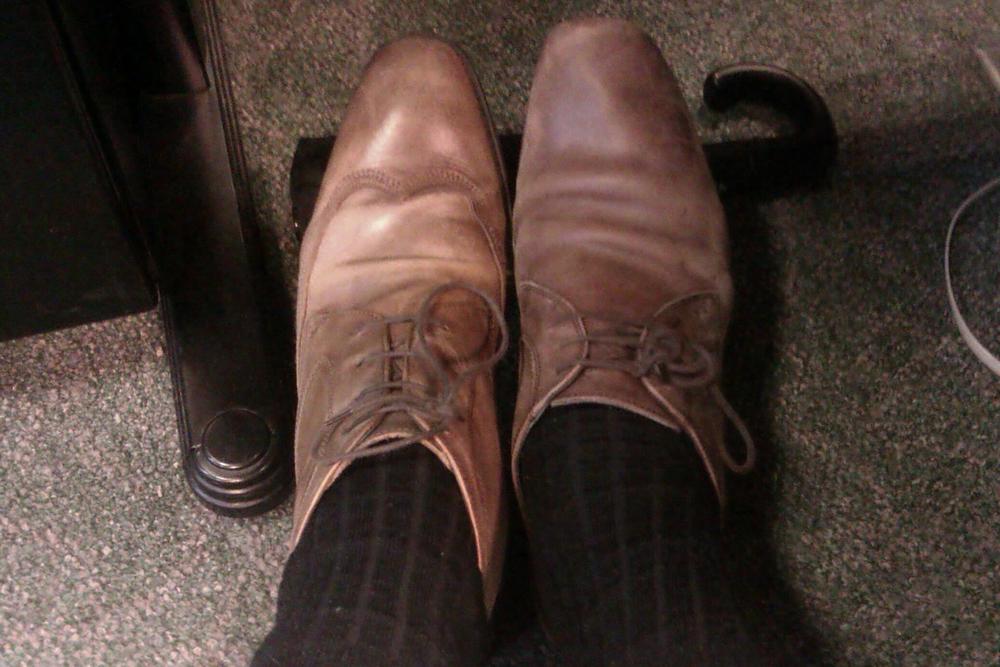
I spent the rest of the day with my feet hidden away under my desk, so that nobody would see this…

Shoeandboot

I was wearing one brown boot and one brown shoe. Also, whenever I stood up I was lop-sided.

I am 40 next week, but I console myself with the fact I could just as easily have done this to myself 20 years ago.

COLUMN: March 2, 2011

I’VE been reading a book which I am finding very absorbing, and I am desperate to discover what happens next.

But it is taking me a long time to read it, because I won’t read it on the bus as I am crippled by social embarrassment.

It’s the third book in the Stieg Larsson Millennium trilogy. You know the ones – they started with The Girl With The Dragon Tattoo. Of course, when the book was written 10 years ago, it was considered very exotic to have a tattoo. These days, it is very difficult to find a girl in her twenties who does not have a tattoo, dragon or otherwise.

En masse, say on a Saturday night in Concert Square, they look like my notebook after a long and boring meeting. They might as well have called it The Girl With The Head.

You see, I was actually what they call in IT circles an early adopter of the first book and bothered a number of people with my insistence that they “really must read this book. It’s not the best written book, but the characters are really compelling and . . . and . . . she’s got this computer, yeah, and, erm . . . It’s Swedish!”

But just as I was about to buy the second part, the whole Larsson phenomenon exploded. Everybody was reading the books, the films were released, IKEA was running tours around the Warrington store – “Look, these are the meatballs Blomkvist ate, and those shelves over there are very like his.”

So when I walked into Waterstone’s to buy book two I saw the huge display of “The Girl . . . ” novels and thought: “I can’t buy this now. I am a serious man who reads the posh newspapers and looks down his nose at Britain’s Got Talent.

“I mean, I did Latin in school. I am basically Michael Gove’s good twin. Buying this book right now will make me look like a chump.” And so I left the shop.

Over the past year or so, as the movie versions have been released, friends and people whose opinions I respect (not necessarily the same thing) have told me, “Oh, you really must see this film. It’s not the best written film, but the characters are really compelling and . . . and . . . she’s got this computer, yeah, and, erm . . . It’s Swedish!”

Of course, I have avoided the films because I wanted to read the books first.

And I haven’t read the books because the films came out. 

I am clearly the victim of bad timing. Obviously not as much as the author, who died before the books were published and made a squillion pounds, but bad timing nonetheless.

But it is a vicious circle of my own making. I have made an apple pie bed and got into it myself.

Thankfully, in the past couple of weeks, I found a loophole. I got somebody to buy the books for me. By this, I mean I was given them as a present. I didn’t loiter by Waterstone’s like a 15-year-old hanging around outside an off-licence. “Hey, mate, can you go in there and get me a Georgette Heyer and a couple of Jeffrey Archers?”

Which brings us back to where we started. Now that I have the books, can I read them in public without looking like the type of person who reads Harry Potter with the “adult” covers?

This sort of consideration did not worry me in the past. I was a comic collector well into my thirties and would think nothing of reading the latest edition of The Adventures Of Superman on the bus. What happened to that devil-may-care larrikin?

So, I have to man up. So what if the people around me think I am uncool? There is nobody more uncool than he who attempts to avoid looking uncool. Apart from he who uses the word “uncool”.

So I will read The Girl Who Flicked V-Signs At Bad Men, or whatever it is called, on the bus, and hang the consequences. And if I lose my nerve, I will simply conceal it behind a copy of The Beano.

COLUMN: February 23, 2011

READERS of the Liverpool Daily Post are probably unfamiliar with the television series The X-Factor. Our research shows that you are too busy listening to Radio 3 or disproving Fermat’s Last Theorem to watch that sort of guff. Thankfully, that’s what I am here for.

Then take it from me that one of the most beloved/derided acts on this talent show in the past few years was the brother-sister duo Same Difference. If you can imagine a camp blonde Donny and Maria Osmond, but much more sinister, you wouldn’t be far off.

Every week I would watch the group and hate them. Hate is not too strong a word, I would despise them. Not because of their perky smiles. Or of their perky dancing. Or of their perky maulings of perfectly decent songs.

It was their name: “Same Difference,” a phrase which, when falling upon my ears, provokes the same sort of physical revulsion as a Michael Winner lapdance. It makes my ears retract into my skull and my spine fuse.

Imagine hook-handed militant cleric Abu Hamza grumpily having to write the line “Some aspects of Western life are actually quite admirable” on a blackboard 50 times WITHOUT CHALK, while Janet Street-Porter sings Delibes’s Flower Duet* with a Dalek. That is what it sounds like to me.

I refuse to believe that I am the only person wound up by a particular phrase, although I am happy to accept that I am uniquely troubled by “same” and “difference.” I know that you, gentle reader, will have your own bugbear phrases. And I apologise if your bugbear is the word “bugbear.”

I am happy to use these words separately, but they vex me severely when used in conjunction. Partly, I think it is because of the occasions on which the phrase is uttered.

This is when somebody has used faulty facts to back up a spurious argument. And when they are caught bang to rights, they use the phrase to gloss over their error, rather than addressing it.

“Churchill was a disgrace. All those men being killed in the trenches while he’s in 10 Downing Street just because he was eating a Big Mac and listening to his iPod . . . ”

“Erm, you know Churchill was Prime Minister in World War II?”

“Yeah, well, World War I, World War II, same difference, innit?”

“And they didn’t have Big Macs then. It was all Spam in those days.”

“All right, a Big Mac made out of Spam and Camp coffee. Same difference.”

“And – and I don’t want you to think I’m any sort of history anorak – as far as I know they didn’t have iPods either.”

“Oh, all right! An earlier model of MP3 player. Same diff . . . argh!”

That’s the point at which the hurting starts.

But it’s not just the intent behind the phrase, it is the phrase itself. It is utterly meaningless. Let’s just examine it for a moment. Same difference. Same, which denotes an identical nature. Difference, which denotes a non-identical nature.

How in the name of Patrick Moore can something be both the same AND different? It’s a paradox like hot ice, cool jazz or a good Jennifer Aniston movie. Only the sort of person who would gloss over errors by saying “Same difference” would use the phrase “Same difference.”

A family friend used to use the phrase “same horse, different jockey” which at least addresses the paradox, if not the faulty facts.

So if you are in my presence and you want to backtrack while keeping your dignity intact, then I will allow you to use that phrase. And I promise I won’t use any words or phrases you find odious.

What do you mean, “it’s Marie Osmond, not Maria”? Oh, well, same difference.

See?

*That’s the old British Airways theme tune for viewers of The X-Factor.


COLUMN: February 16, 2011

I AM becoming increasingly concerned by misleading packaging. By this, I don’t mean outlandish claims on packaging like “Special K: Makes you fit in a slinky red dress even if you are a man”, “Mars: Helps you work, rest, play and see through walls” or “Dr Pepper: It tastes nice.” Legislation has more or less dealt with excesses like this.

And I certainly wouldn’t want us to go too far the other way. Although that is probably already happening.

I saw a packet of cream crackers recently which had a picture of one of the crackers with a piece of cheddar on top along with a sprig of parsley. Underneath the picture was the legend “serving suggestion.”

Really, if you need a serving suggestion for cream crackers, then you probably shouldn’t be allowed the knife to cut the cheese anyway.

No, the problem is with items which should be packaged in a particular way but actually appear in another. As an example, take the cheese and onion crisp.

For years, the cheese and onion crisp was associated with the colour green.

If you picked up a packet of Tudor Crisps, Smith’s Crisps, even Golden Wonder Ringos, and it was green, you knew what you were getting. Blue was for lovers of salt and vinegar, red was ready salted, there was some leeway around the exact shade of mustard for roast chicken crisps but that was about it.

The point is, if you didn’t like salt and vinegar, you knew to steer clear of the colour blue.

Then Walker’s came along with their blue cheese and onion crisps and green salt and vinegar, totally messing up what had been a perfectly good system and turning choosing a crisp from a proffered packet into snack Russian roulette.

I rued the current tendency towards misleading packaging this morning* when I showered. For the purposes of this column, it is necessary for you to be aware of the mechanics of my morning shower. I am as uncomfortable with this as you – and I’d be grateful if you would strike it from your memory at your earliest convenience – but this is for the greater good.

OK, for speed’s sake, I shave in the shower. Only my face, I am not a weirdo.

But, for the sake of tonsorial balance, I have to shave around my sideburns outside the shower and in front of the mirror.

I squirted the shaving gel into my hand, noticed there wasn’t much left, lathered up, put the gel back on the shelf, and all went well. I did get a bit of shampoo in my eye.

As I grabbed the towel to extract the errant shampoo, I picked up the shower gel, squirted it straight onto my rugged manly chest, and realised I’d used the last of the shaving gel. It wasn’t my fault – the bottles are the same size and colour. I was misled by the packaging.

“For sensitive skin,” the shaving gel states. I am sorry to report that that is not entirely the case.

Luckily, I managed to remove it before it caused lasting damage.

I threw the empty shaving gel bottle into the bin, climbed back into the shower, reached out a hand, squirted the shower gel onto my rugged manly chest and discovered I had picked up something suffused with ylang-ylang and lavender.

None of this is my fault. If toiletries manufacturers don’t have the wit or inclination to produce packaging which gives more of a clue as to their contents, then I should be allowed to sue them.

And if you think I am overreacting, then I remind you that you’re not the one who had to go to work feeling like a lady, and strangely peckish for a bowl of Special K. Unless you are a lady, of course.

*WHEN you read this, it will be “yesterday morning”, but I shouldn’t be surprised if it happens to me again today.

COLUMN: February 9, 2011

I’M QUITE mild-mannered, really. If I worked on the same newspaper as Clark Kent, and somebody referred to “him over there with the glasses, the mild- mannered one” they would be talking about me.

It takes quite a bit to rile me: somebody parking across two bays, Piers Morgan’s continuing success, hearing the words “Chancellor George Osborne.”

But nothing has got my dander up quite so much and so often as a social networking site of which I, until very recently, was a member. For legal reasons I will not name the site in question. Hereafter, I shall refer to it, entirely appropriately, as LockedIn.

LockedIn allows business people to set up connections between themselves and other business people. If you can imagine Facebook without any warmth, wit, or sheer positivity of the human spirit, then you’re very close to understanding what LockedIn is all about. You’re also very close to understanding what Facebook is all about.

I was press-ganged into LockedIn by a former colleague and zealot supporter of all manner of social networking sites. “It’s really good,” she said. “You can connect with all sorts of people who could help your career.”

“All right,” I said. At this point, the only person who could help my career would come equipped with paddles and a defibrillator, but I gave in and set up an account.

For around the next 12 months, my colleague was my only connection on LockedIn. And that was fine. I didn’t trouble LockedIn and it didn’t trouble me. I forgot about it.

And then, one day, an email arrived. From LockedIn. “Oh, yes,” I vaguely remembered. “That’s the site that was going to connect me, etc.” The email was a notification that somebody wanted to connect with me. This somebody sits roughly 15 feet away from me. And if he was going to help me with my career he’d have done it long ago. In any case, I couldn’t remember my password, so I left it. But LockedIn wouldn’t. Every few days, it would send me another little reminder. And another, like a passive- aggressive nag. I buckled.

But, over the next six months, I received an email from LockedIn every other day, asking me to check in and confirm that I knew people. I stopped being discriminating. I would accept anybody, just to stop the needy little site wheedling away.

The final straw came when somebody I slightly knew asked me to write her a recommendation. “I am not a vicar,” I railed. “I can’t write a eulogy for somebody I don’t know.”

I logged on and spent 20 minutes trying to find the hidden instructions on how to destroy my account. The best it would let me do is deactivate my account. That was OK, it had nothing of use in there.

Even then it begged me to tell it why I was leaving. “Look, it’s not me, it’s you,” I told it, albeit at greater length. It felt liberating. I could begin my life again.

Then, at 4.30am on Monday, my email alert rang on my phone, waking me. I checked it. It was LockedIn, the jealous ex, telling me that another work colleague from 10 feet away wanted to connect with me. And there was a little note at the bottom. “Don’t want to receive email notifications? Adjust your message settings.”

But I couldn’t! I’d deactivated my account! Wasn’t that a big enough clue? What did I have to do? Take out a 30-second ad during Britain’s Got Talent? Change my name to Lockedin Isrubbish? Not only was my dander up, but they had also got my goat and were twisting my melon.

I wrote them an email in anger.

“Dear LockedIn,

“I deactivated my pointless account. Stop sending me email reminders at 4.30am, you magical bunch of shit-for-brains idiots.

“Yours lovingly,

“Gary Bainbridge.”

I’ve had nothing since, but I know this isn’t over.